
Fire and the Darkening of the Light: Saturn Enters Aries
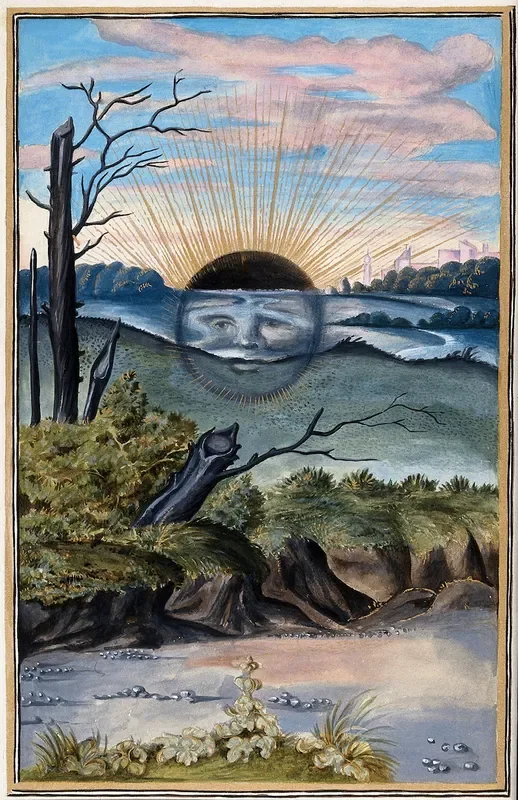
Salomon Trismosin's Splendor solis (1582)
For the past couple of years, my blog posts have centered on the cycles of the New Moon and Full Moon. That rhythm felt steady and grounding to me. But as we move further into 2026, I’ve felt ready to widen the lens.
Instead of writing at every lunation, I’m going to focus more on significant planetary transits. Transits are the ongoing movements of the current planets in the sky and how they interact with that birth chart over time. They describe timing. They show when certain parts of your chart are activated, challenged, supported, or matured.
In today’s post, I’m taking a closer look at one of the longer astrological cycles: Saturn’s recent movement into Aries. As Saturn moves through Aries, the area of your chart ruled by Aries is brought into focus. That part of your life may feel more serious, more demanding, or more defined. Questions of identity, independence, and self‑assertion arise there, and you may feel pressure to clarify who you are and how you want to move forward.
In alchemy, Saturn was associated with the Black Sun, a symbol of the dark beginning of a transformation process. Alchemy was an early philosophical and spiritual tradition that used the language of turning lead into gold as a metaphor for inner change. Modern psychology, especially Jungian psychology, later interpreted alchemy as describing stages of personal growth. The “Black Sun” represented a phase where old structures break down, confusion sets in, and you can’t yet see what the new form will be.
That image can help describe how this transit may operate in the Aries area of your chart. Something there may feel stripped back or unsettled, as if what once felt solid no longer quite fits. But in alchemy, that dark phase wasn’t the end of the story. Saturn was also linked to the stone that remained after long effort and refinement, the stable foundation that could endure. The work happening in your Aries house now is ultimately about building something steadier and more sustainable in that part of your life, even if the process begins with uncertainty.
This transit will be especially significant if you were born with Saturn in Aries, as you’ll be entering your first (age 29-30) or second Saturn return (age 58-60). If that applies to you, be sure to read the section at the end of this post where I explore what this period can mean on a more personal level.
You may also feel this transit more strongly if you have a cardinal rising sign—Aries, Cancer, Libra, or Capricorn—as Saturn will be moving through an important house of your chart.
If you’d like a more individualized understanding of how Saturn in Aries may show up in your life, you can book a reading using the link below.
This transit will be with us for a while, unfolding over the next few years. We had a preview of its energy last summer when Saturn was in Aries for a brief period from May to September. It returned to Aries on February 14 and will remain there until April 2028. After a brief return to Pisces, Saturn will re-enter Aries again from February 2029 through April 2030.
I’ve been thinking about this transit more deeply than usual, partly because I recently finished a seminar series on Saturn by astrologer Liz Greene. One of the things she emphasizes is that Saturn can’t be reduced to a simple keyword. It’s not just “restriction” or “hard work.” It’s a much bigger psychological pattern — something that has shown up in myth, religion, art, philosophy, and psychology for centuries.
When we talk about Saturn, we’re talking about a symbol. And a symbol always has two sides — the part we can see and name, and the part that’s harder to define but that we feel or experience.
The Archetype of Saturn through Myth and Image
One of the most unsettling images of Saturn is Francisco Goya’s Saturn Devouring His Son, based on the Greek myth of Kronos swallowing his children. Goya painted it late in his life, after living through the Napoleonic invasion of Spain, the brutality of war, famine, and political repression. By then he was older, deaf, and deeply disillusioned with what he had seen happen to his country. This was a personal piece that he never showed in public; it was one of the “Black Paintings” he painted directly onto the walls of his own home.
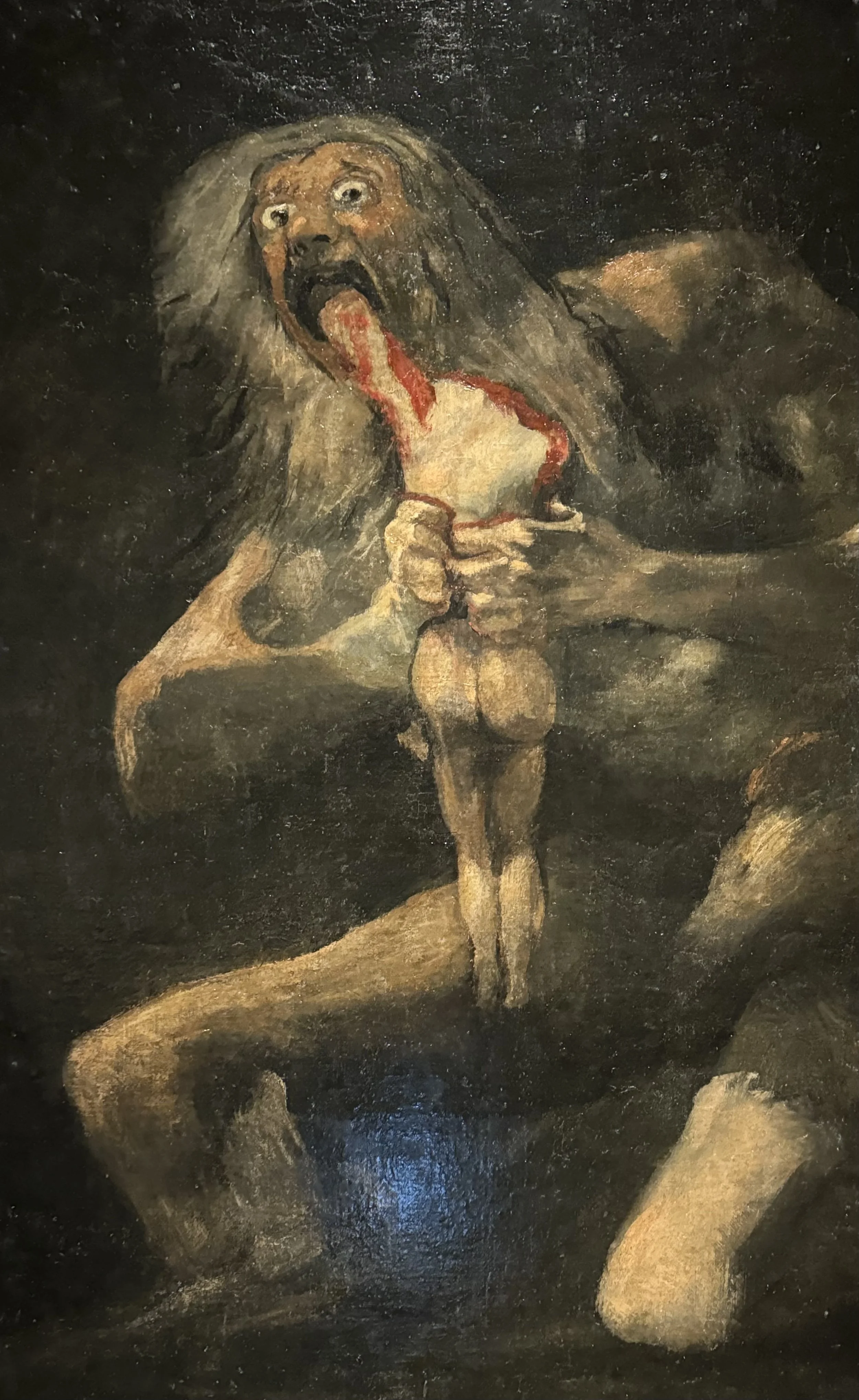
Goya, “Saturn Devouring His Son,” personal photo (Prado Museum)
In the myth, Kronos swallows his children because he’s been told one of them will overthrow him. He tries to stop the cycle. He tries to prevent the future. Instead of allowing time to unfold, he attempts to control it by destroying what comes after him.
At its core, that myth is about fear of losing control — about trying to stop time itself. Kronos doesn’t want the cycle to continue. He doesn’t want to be replaced. So he destroys what comes after him.
Psychologically, that’s one face of Saturn. It’s the part of us that would rather shut something down than risk uncertainty. The part that suppresses our own potential because growth feels threatening. The defenses we build so we don’t have to feel vulnerable. The way we can “swallow” parts of ourselves — our creativity, our anger, our independence — because letting them live feels too dangerous.
But Saturn isn’t only about fear and control. There’s another image that captures a different side in Albrecht Dürer’s engraving Melencolia I. It shows a winged figure sitting quietly, surrounded by tools for building and measuring. Everything needed to create something meaningful is there, but nothing is happening yet. Instead of panic or destruction, we see stillness, delay, and concentration. It’s a very different expression of the same archetype: not devouring what threatens you, but sitting with the weight of what has yet to take form.
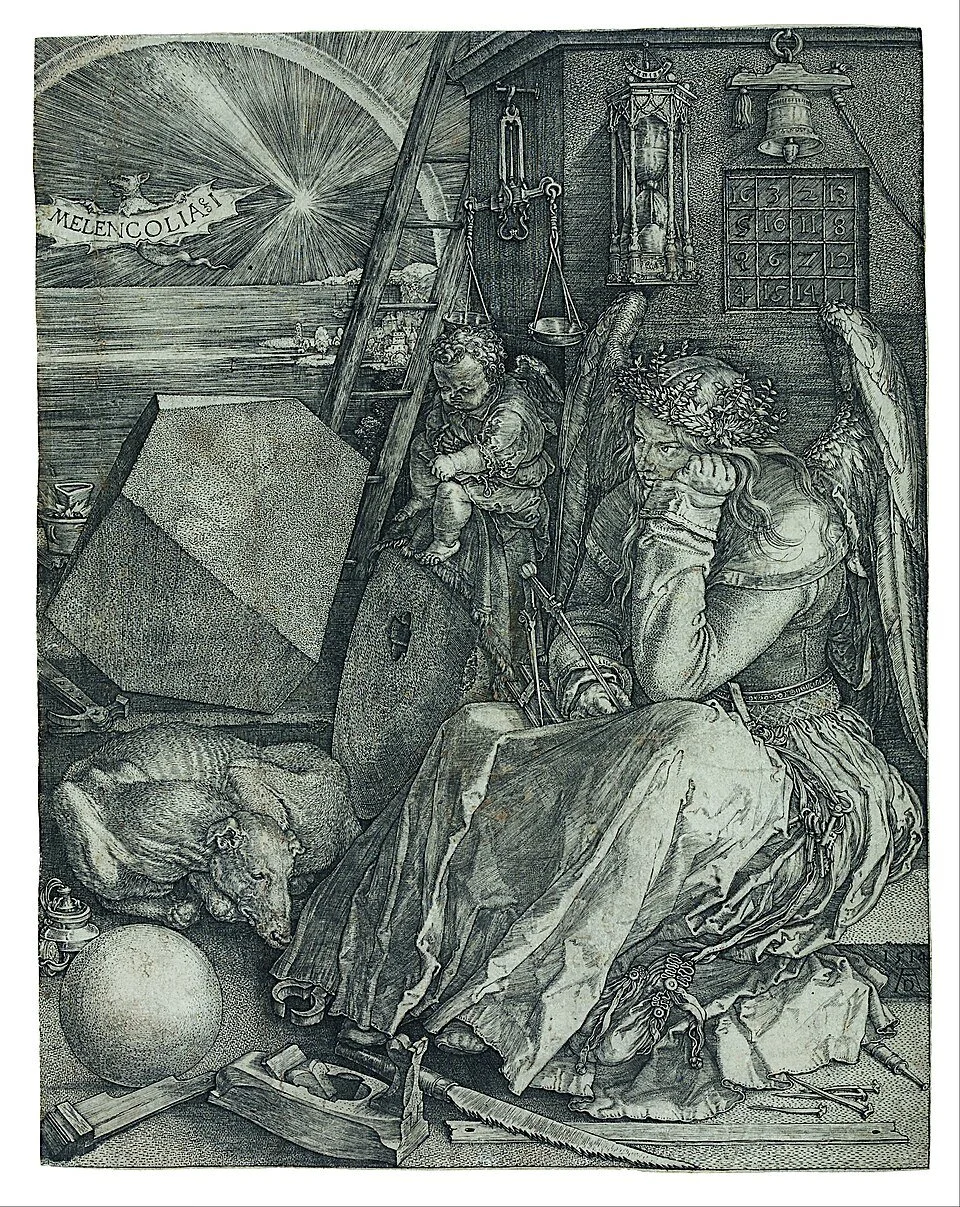
Albrecht Dürer, Melencolia (1514).
In earlier centuries, melancholy or what we now call “depression,” wasn’t immediately treated as something that needed to be fixed. It was often understood as a reflective or transitional state, a period of inwardness that could lead somewhere meaningful. If you stayed with it instead of trying to escape it, it was believed that insight and depth could develop over time. Saturn can feel heavy, but that heaviness can also mature you and give your experience more substance.
Greene traces this theme through alchemy, where Saturn was associated with the “black sun,” a symbol of the dark beginning of the work. This stage was linked to confusion, breakdown, and even a sense of failure, as old forms dissolved and nothing stable had yet replaced them. But Saturn was also connected to the end of the process, represented by the stone itself, the solid foundation that remains after the work has been done. In that sense, Saturn governs both the difficult beginning and the lasting structure that eventually emerges.
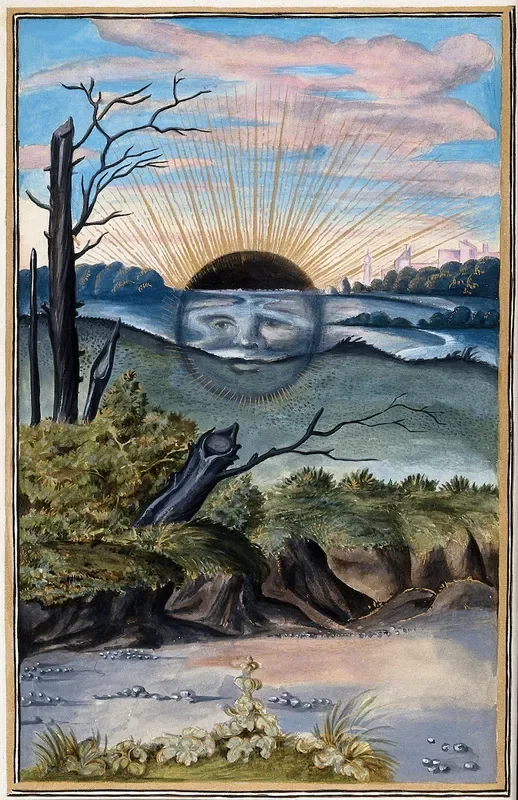
Salomon Trismosin's Splendor solis (1582)
Saturn is associated with stone for a reason. Stone doesn’t shape itself; it has to be carved and worked over time. There aren’t shortcuts in that process, and nothing is simply handed to you. But once the structure is formed, it can support everything built on top of it. As I often say, Saturn rewards consistent effort over a long period of time because it builds structures that last. That’s the side of Saturn that sometimes gets overlooked: the work may be slow and demanding, but what you build through it tends to endure and isn’t easily taken away.
Another theme Greene emphasizes, and one that can be uncomfortable to acknowledge, is envy. This isn’t romantic jealousy, but the feeling that someone else has qualities or strengths you long to develop in yourself, such as confidence, talent, authority, ease, or creative power. Psychologically, envy often hides a deeper wound: the fear that we aren’t enough.
In older myths, envy is actually described as Saturn’s sin. The impulse to spoil what one cannot create. And Greene, a Jungian analyst (psychologist) and astrologer, makes a subtle but powerful point: we only envy what we value. Envy tells us something about what matters most to our soul.
If we don’t work with that feeling consciously, we tend to project it outward and see in others what we struggle to tolerate in ourselves. We might idealize them, resent them, or move back and forth between the two. Families can carry this pattern across generations, especially when qualities like creativity, ambition, or independence are subtly discouraged because they stir up unresolved envy in someone who never felt permitted to express those traits. Saturn asks us to recognize that dynamic and take responsibility for our own unlived potential instead of disowning it.
It’s also about boundaries. Saturn is the part of life that makes it clear when something is over and can’t be undone. At a certain point, you can’t go back to who you were before you knew what you know now. You have to grow up, take responsibility, and live with the consequences of your choices. In that way, Saturn marks a threshold and asks you to move forward, even if part of you would rather stay where things felt simpler.
Saturn in Aries
As Saturn moves into Aries, those themes begin to play out in a sign that approaches life very differently. Aries is the sign of “I am.” It’s instinctive, bold, and fast, tending to act first and figure things out later. It’s associated with independence, courage, anger, and initiative. It’s the beginning of the zodiac, the first spark of life pushing forward, wanting to exist and to make contact with the world. Check out my YouTube Video on Aries I, the first 10 degrees of the sign, if you’d like a deeper sense of this energy.
There’s something raw about Aries, a quality that feels immediate and unfiltered. It doesn’t tend to wait for permission or for someone else to make the first move; it initiates. Rather than pausing to carefully weigh every possibility, Aries often responds in real time, acting on instinct and meeting life head‑on. When that energy is expressed well, it shows up as courage, directness, and a kind of unapologetic authenticity. When it’s coming from a more reactive place, though, the same impulse can turn into impatience, impulsiveness, or defensiveness.
Saturn, by contrast, is slow and cautious. Aries is immediate and impulsive. Saturn plans; Aries leaps. When Saturn moves through Aries, there is an inherent tension between urgency and restraint.
On a personal level, this can bring up questions around self‑assertion. Do you feel comfortable taking up space, speaking directly, saying no, or starting something new without waiting for permission? Do you trust your instincts, or do you second‑guess yourself?
For some people, Saturn in Aries can feel like blocked confidence — a desire to move forward paired with hesitation. For others, it may show up as frustration when action doesn’t bring instant results. Aries wants movement. Saturn asks for patience. Saturn slows Aries down and requires that action be grounded in something steadier than impulse.
If Saturn represents the place where we feel tested, then in Aries that testing can center around courage, individuality, anger, leadership, and the right to exist as yourself. It may bring up old stories about whether it was safe to be bold, to be first, to take initiative, or to express anger directly.
You might notice strong reactions to people who seem confident or self‑assured. That reaction can sometimes contain envy. If it does, it’s worth asking what their boldness represents to you, because often it points toward something in you that wants development.
Collectively, this transit may highlight where force is used without responsibility, where impulse overrides reflection, or where leadership lacks accountability. Aries brings the fire. Saturn brings the structure. The work is learning how to let those two coexist.
If your Saturn is in Aries: Saturn Return
This transit is especially important for anyone entering a Saturn return. A Saturn return happens roughly every 29 to 30 years, when Saturn returns to the same sign and degree it occupied at your birth. If you were born between April 7, 1996 and June 9, 1998 or October 25, 1998 and February 28, 1999, you’re entering your “first Saturn return” during this period. If you were born between March 3, 1967 – April 29, 1969, you’re entering your “second Saturn return.”
A Saturn return is often described as a maturation point, but that can sound abstract. More concretely, it’s a period when the structures of your life are tested. Anything built on avoidance, fantasy, borrowed expectations, or fear tends to show strain. Anything built with integrity tends to strengthen.
It is also a time when you are setting up structures that will shape the next 29 to 30 years of your life. The decisions you make now — about work, relationships, boundaries, health, and commitments — tend to have long‑term consequences. Saturn isn’t concerned with short‑term relief. It’s concerned with what will actually hold up over time.
During a return, you may find yourself making practical, sometimes difficult adjustments. That can mean committing more seriously to something, stepping away from what isn’t sustainable, or accepting limits you previously avoided. The focus is on stability and accountability — creating a framework for your life that you can realistically maintain.
Individually, the first Saturn return — around age 29 or 30 — is often about becoming accountable for your own life. Up until that point, many of us are still living inside inherited stories: family expectations, cultural timelines, unexamined ambitions. During a first Saturn return, there is usually some confrontation with reality. Relationships either deepen into commitment or dissolve. Careers solidify or shift. You may realize what you don’t want as clearly as what you do. The question underneath it all is: What are you actually building?
The second Saturn return happens around the age of 58-60 and carries a different tone. It is less about establishing yourself and more about evaluating what you’ve built. There can be a reckoning with time, legacy, physical limits, and long‑term consequences. Some structures are reinforced. Others are released. The deeper question becomes: What is strong enough to carry me forward? What no longer needs to?
A Saturn return does not automatically mean crisis, but it does bring a certain seriousness. Saturn has to do with responsibility, limits, effort, and reality. When it returns to its natal position, you are usually asked to take ownership of your life in a more concrete way.
With Saturn in Aries, this process can feel especially personal. Questions about independence, anger, initiative, leadership, and identity may come forward. You may need to define yourself more clearly and decide where you stand. It can bring up places where you hold back, where you react too quickly, or where you’ve relied on force instead of clarity.
A Saturn return is ultimately about getting into alignment with your actual life. It tends to expose what isn’t sustainable and puts pressure on you to make changes that are practical and real. The goal isn’t perfection. It’s stability. It’s about building something you can live with over time.
It isn’t always easy, but it is significant. For many people, it marks the beginning of a chapter where decisions feel more intentional and less driven by proving something to others.