
Aquarius III: Ideals Rooted in Lived Experience
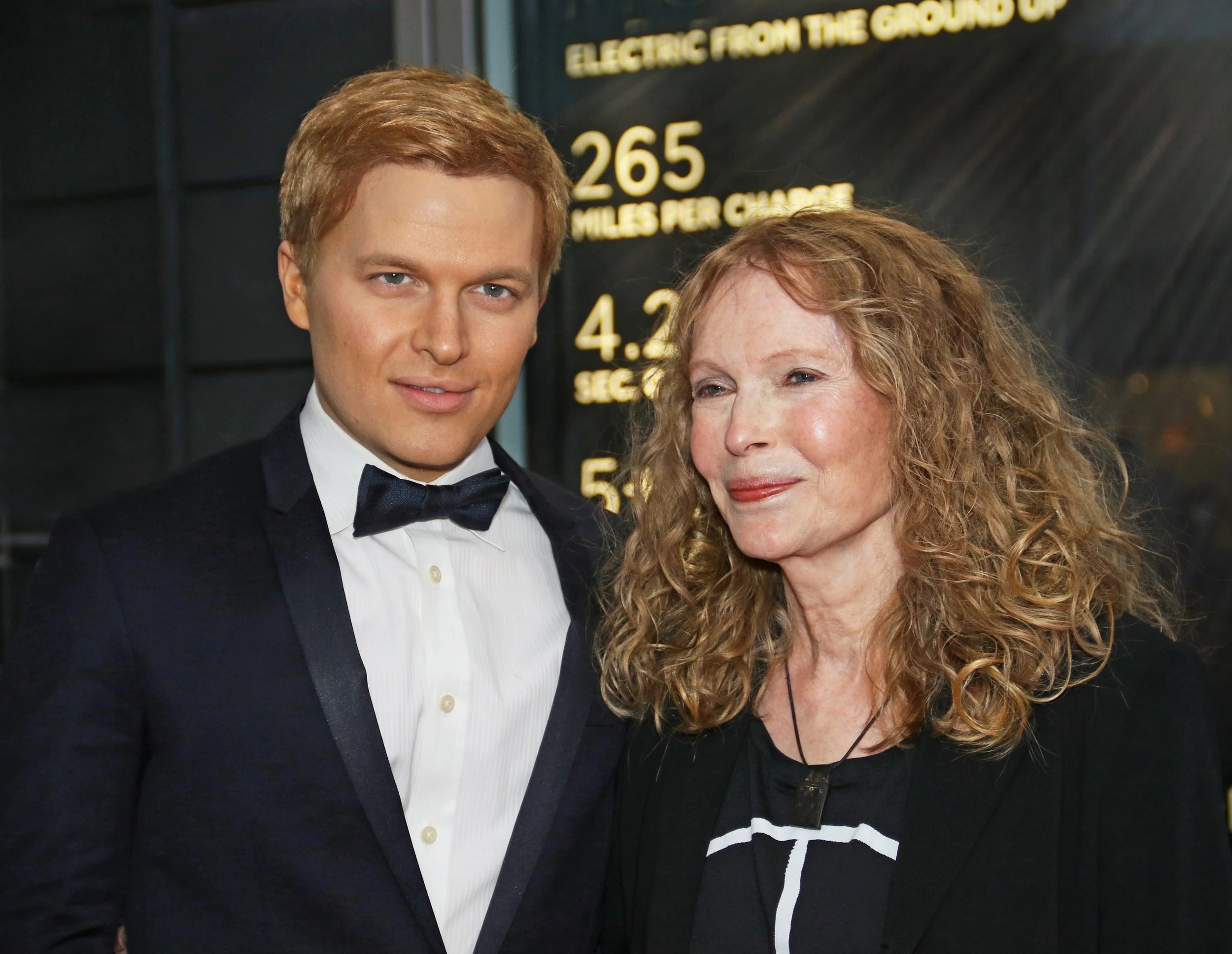
Ronan Farrow with his Mother, Mia Farrow, Dreamstime.com
In the video below, I explore Aquarius III, the third decan of Aquarius and the part of the sign where ideals are tested in real life. If Aquarius I is the outsider leaving the known behind, and Aquarius II is confidence in one’s own inner authority, Aquarius III is the moment we are pulled back into the world and asked to work strategically within its limits. With Venus and the Moon ruling this decan, there is a relational and emotional layer that shapes how these ideals are expressed.
At its heart, Aquarius III is about deciding what can actually be carried forward. The Seven of Swords in the tarot captures this tension: the figure who cannot take everything, who must move carefully and think ahead. This decan often brings up questions of loyalty, memory, and attachment. Netsach on the Tree of Life adds another layer, pointing to endurance, desire, and the bonds that still hold us even as we try to move forward.
In the video, I explore the Rider–Waite imagery, the fixed sign sevens across Taurus III, Leo III, and Scorpio III, and how this final decan of Aquarius fits into the larger arc of the sign. I also look at the chart of Ronan Farrow, whose rising degree falls in this decan. His life reflects key Aquarius III themes: personal history shaping public action, strategic timing, and the careful work required to bring difficult truths into the world.
Transcript (Revised and Expanded)
Introduction
Hi, this is Cathy Gnatek. I’m continuing my series on the 36 decans of the zodiac today with Aquarius III, the last 10 degrees of the sign. I’ve already done a couple of videos on Aquarius I and Aquarius II, and I’ll link those below.
If Aquarius I is the energy of the outsider, the person in exile or the person who makes a deliberate choice to leave the structures of society—of what’s known—in order to enter into the unknown, and Aquarius II is that energy of being confident in that “outsider” status, of being one’s own inner authority, Aquarius III is the moment when we come back, or get pulled back, into life to bring some of those ideals as the outsider down into the world. It also involves understanding the limitations of that effort and acting strategically.
So we’re going to find that people with points or planets in this part of the zodiac tend to bring some of their own history into the expression of their ideals out into the world. We’re going to see that with Ronan Farrow, who has his rising degree in this part of the zodiac. I’ll also explore the Seven of Swords tarot card, which is associated with this 10 degrees, as well as Netzach in the Qabbalistic Tree of Life. And the decanic rulers—Venus and the Moon, the two relational planets—rule over this part of the zodiac. So there’s a lot to talk about.
I hope you enjoy the video. If you do, it would be great if you could like and subscribe. I’m trying to grow my channel right now.
Aquarius: The Sign
Let me first talk about Aquarius, the sign, and its energy in general. For a deeper understanding of the sign, check out my video on Aquarius I. I go through the Ganymede myth that’s associated with Aquarius there, and I’ll drop a link.
In general, Aquarius is an air sign. All the air signs are about communication, thought, and ideals. They have a curious quality. This last of the air signs is about ideas and the community as a whole. The first air sign, Gemini, is more personal. It’s about my thought, my exploration of my ideas. Libra, the second of the air signs, is about your thought and my thought together—balancing that energy. But when we get to the last of the air signs, it’s about society as a whole.
So we’re going to find that people with points or planets in Aquarius tend to be concerned with greater thoughts around what will benefit humanity, as opposed to themselves individually. Again, I go into that a little more in the Aquarius I video.
Saturn, the last planet we can see with the naked eye, rules Aquarius. Saturn is about boundaries and limitations—what’s included and what’s excluded. When we get to Aquarius, it’s about the energy of the great, vast unknown, as opposed to Capricorn, the other sign ruled by Saturn, which is an earth sign and is more about what’s included in the known. Capricorn is an earthy sign about ambition and creating structures in the material world. When we get to Aquarius, we’re moving beyond that.
As I said earlier, the first decan of the sign has to do with exile—leaving home and exploring my own thought. The last thing to understand about Aquarius is that it’s a fixed sign. So it has a stable, enduring, consistent quality and a desire to create thought structures that benefit the world.
Think of the man who wrote The Communist Manifesto—his name escaped me for a moment—Karl Marx. That idea of coming up with a system can be very Aquarian.
Decanic Rulers: Moon and Venus
When we get to the third decan of the sign, one of the ways we differentiate it from the other decans is by looking at which planets rule it. For Aquarius III, it’s Venus and the Moon. Both are relational planets. Venus is the ruler under the triplicity system. Venus is the goddess of love and attraction, harmony and beauty, pleasure and values, but also justice and connection—how you receive love.
The Moon, of course, represents our body. It also represents memories and our history, because memories are stored in the body. You can think of the unconscious as being related to the Moon, whereas the Sun is related to what we’re aware of—conscious energy. The Moon relates to mothering and nurturing, emotions, our inner life, our intuition, and our instinct.
We see that when people have points or planets in this part of the zodiac, it’s as though they are being drawn back into the real world around their ideals—whatever ideal structure they’ve come to know for themselves because they’re centered in their own inner integrity.
The energy of this last part of the decan is: What do I do with those ideals that I’ve come to know when I encounter situations in my own personal life that bring up my own memories or my own karma, you could say? How do I bring them back into the world? What difficulties might I encounter?
This is a decan ruled by Saturn, which is about limitations, and also by Venus and the Moon, which are about harmony, connection, and nurturing. When you put those planets together, that’s the tone of someone with points or planets here. There may be a seriousness around wanting to bring those ideals into the world in a way that is nurturing, harmonious, and promotes justice. We see this with Ronan Farrow, who has his rising degree in this part of the zodiac, and I’ll talk about that at the end.
Tarot Correspondence: Seven of Swords
We really see the conflictual nature of this part of the zodiac in the Seven of Swords card. We see a figure slipping away from a camp, carrying as many swords as he can. He’s glancing back over his shoulder. Two swords remain behind. The image suggests partial success or a conscious decision to take what is possible.
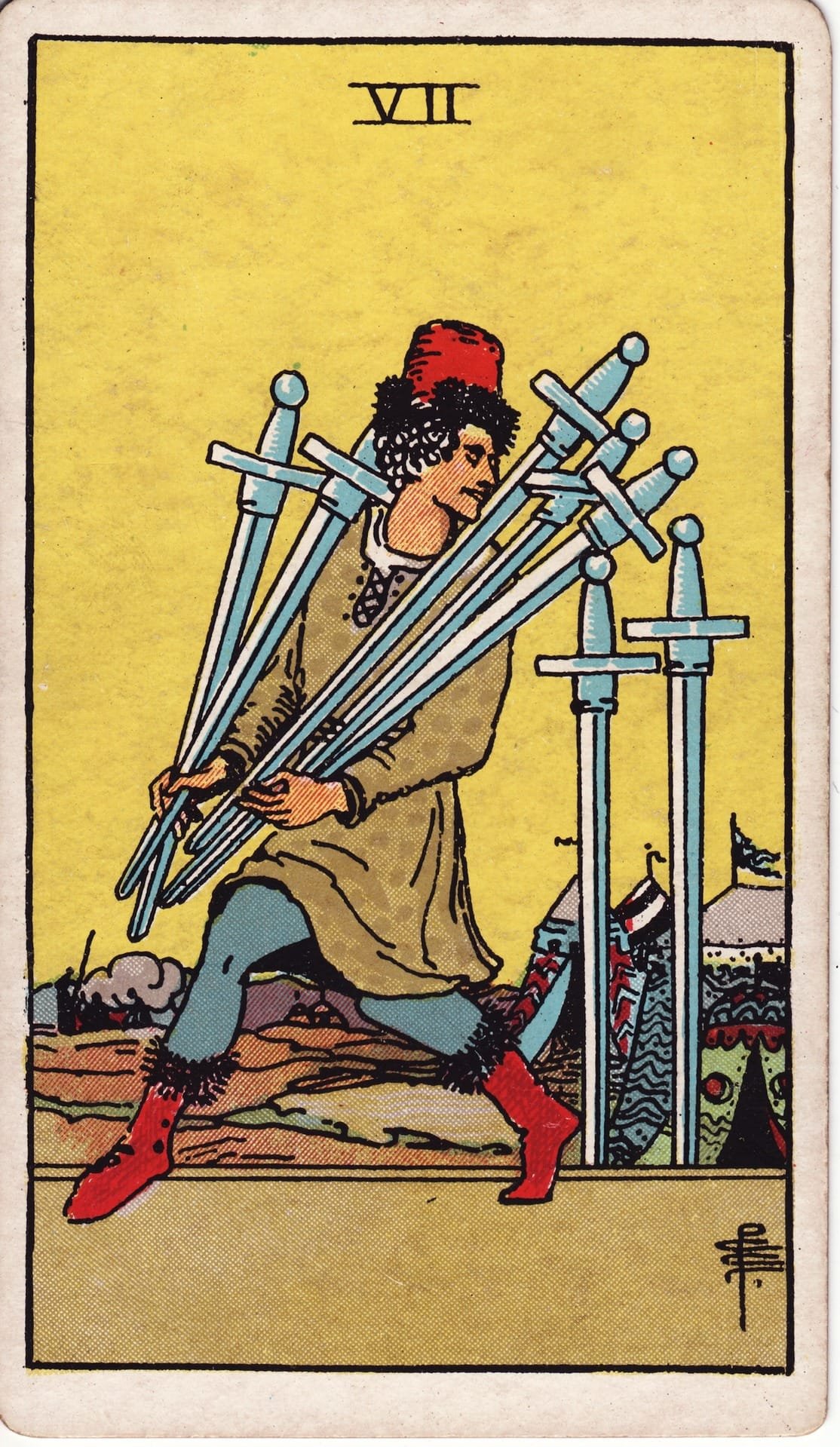
7 of Swords, Rider-Waite Tarot
It’s not a clear-cut situation. He’s not taking all the swords and leaving forever. There is some connection that remains. This is a card that can have to do with strategy rather than confrontation. There’s no open battle here. Instead, there’s timing and awareness. He is carefully maneuvering in order to take these away.
The situation is complicated enough that you cannot simply win outright and walk away untouched. You must decide what can be carried forward and what must stay behind.
Austin Coppock, who has a series on the decans—a class that I took as well—refers to this part of the zodiac as the Gordian Knot. He talks about the fact that people with placements here can feel a temptation, because the Gordian Knot is so complex and difficult to untie, to simply cut it and break free. The other possibility is to go through the long, hard, strategic work of untangling the threads of the situation you’re in.
This is the two-sided energy of this part of the zodiac. There can be people—I noticed a couple, including Sylvia Plath and another person who had their rising degree in this part of the zodiac—where there is a decision to cut through and end things as a way to resolve the tension and complexity of this energy.
At the same time, there can be an enduring quality. People with points or planets here may endure the tension of the unknown around thought and the important, painstaking work it can take to bring their thought, their ideal, into the world—and how that is tied to their own circumstances of origin. Again, we see that with Ronan Farrow. I’ll get into that example later, but it’s a clear one.
So this decan is complex. All the sevens in the tarot deck, as well as the last 10 degrees of the fixed signs, have this quality of enduring a situation for the sake of manifesting something important in the world—being able to stay present to the unknown and to have your ideals worked over for the sake of something greater. I’ll talk about that a little more as well.
The last note I wrote to myself here speaks to this idea of entanglement around thought as part of the energy of this decan.
Hermetic Qabbalah: Netzach on the Tree of Life
Now let’s move to the Tree of Life in the Hermetic Qabbalah. There is also the ancient Jewish Kabbalah, but I’m speaking here about the Hermetic tradition.
The Tree of Life is a mystical diagram that represents the descent of divine inspiration into the material world. There is a lightning flash that moves from Keter to Chokmah to Binah to Chesed, and so on, all the way down to Malkuth. It traces the flow of creative energy from divine source at the crown to the physical world at the bottom. This process illustrates how spiritual concepts take form and manifest in reality, connecting the divine to the earthly realm.
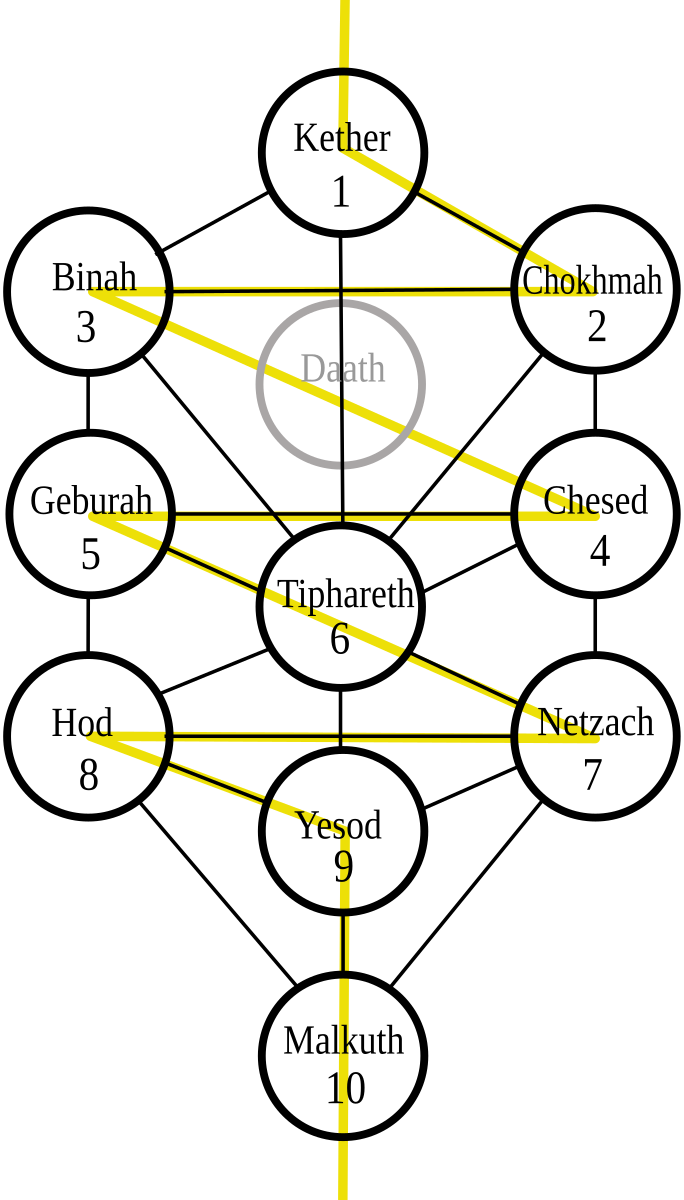
Tree of Life, Hermetic Qabbalah
When we get to the seven, we have moved from Tiferet, which is the heart at the center of the Tree of Life—a balanced point of knowing—into a deeper push into the world, where you encounter potential obstruction. There is a certain amount of faith and endurance required to maintain the energy to understand and to be worked over by the divine for the sake of manifesting something new in the world.
The number seven on the Tree of Life corresponds to Netzach, the sphere of desire and endurance on the Pillar of Mercy. It is about attachment, persistence, and what we are still emotionally tied to. If you think back to the Venus–Moon quality of this decan, you can see that emotional connection in this part of the zodiac—still being tied, in some ways, to our history, to embodied understanding, to karma around ideals. We will see this clearly in the example of Ronan Farrow, because it ties all of these threads together.
Moving from the six to the seven shifts us from clarity into complication. Tiferet knows the ideal. Netzach asks: what happens when desire, frustration, and loyalty become involved? Netzach teaches that some bonds linger. In Aquarius, this can show up as sharp critique mixed with continued involvement—wanting distance but not fully leaving.
The lesson is simple, but uncomfortable. You may not be able to carry every part of your ideal forward. You must decide what stays, what goes, and what still holds you.
The Tarot Sevens and the Fixed Signs
As I mentioned earlier, all the sevens in the tarot deck correspond with the last 10 degrees of the fixed signs in the zodiac. They are about endurance. They mark the testing of harmony in real life—endurance with faith, the will to keep moving forward when ideals meet resistance and the world becomes complicated and messy.
With Taurus III and the Seven of Pentacles, we see the earth expression of endurance in the midst of the unknown. It’s the sense of: I’ve done all this hard work to create something. What if a storm comes along and destroys my crop? I have to stay present to that possibility and keep holding my project, even knowing it may fall apart.
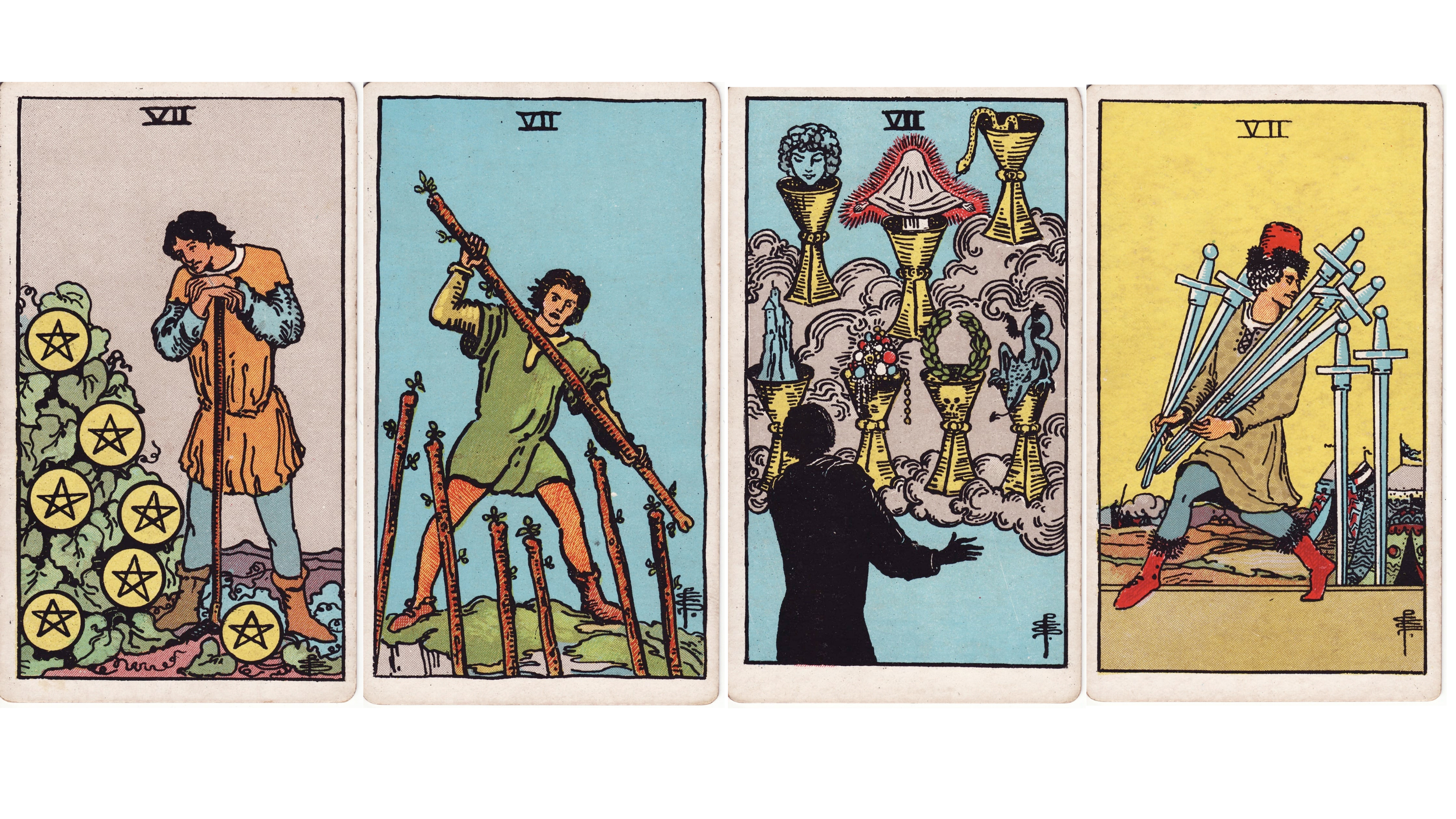
Then we have the fire expression of endurance in Leo III. I am an inspirational force bringing a creative spark into the world. What do I do when I encounter resistance to how amazing I am?
Then we have the water expression in Scorpio III, which is about longing to connect—with the divine, with source, with other people. All water energy relates to emotions, containers, and connection. What do I do when I am in a moment of multiple desires and longings and I’m not sure which one is truly for me? How do I stay centered in myself in the midst of all these dreams without losing my inner direction?
And then, of course, we have the airy energy of thought in Aquarius III and the Seven of Swords—how thought must endure in the face of critique and possible confrontation when bringing new ideas into the world.
Example Chart: Ronan Farrow
We really see this exemplified in the chart of Ronan Farrow. With the Seven of Swords, what needs to happen is strategy. Bringing a new idea into the world requires care and timing. It requires being strategic so that it can actually manifest.
Ronan Farrow is an American investigative journalist, lawyer, and author. He is the son of Mia Farrow and Woody Allen. He is best known for his reporting in The New Yorker on sexual abuse allegations against film producer Harvey Weinstein. His work helped fuel the “Me Too” movement, and he earned the 2018 Pulitzer Prize for Public Service for that reporting.
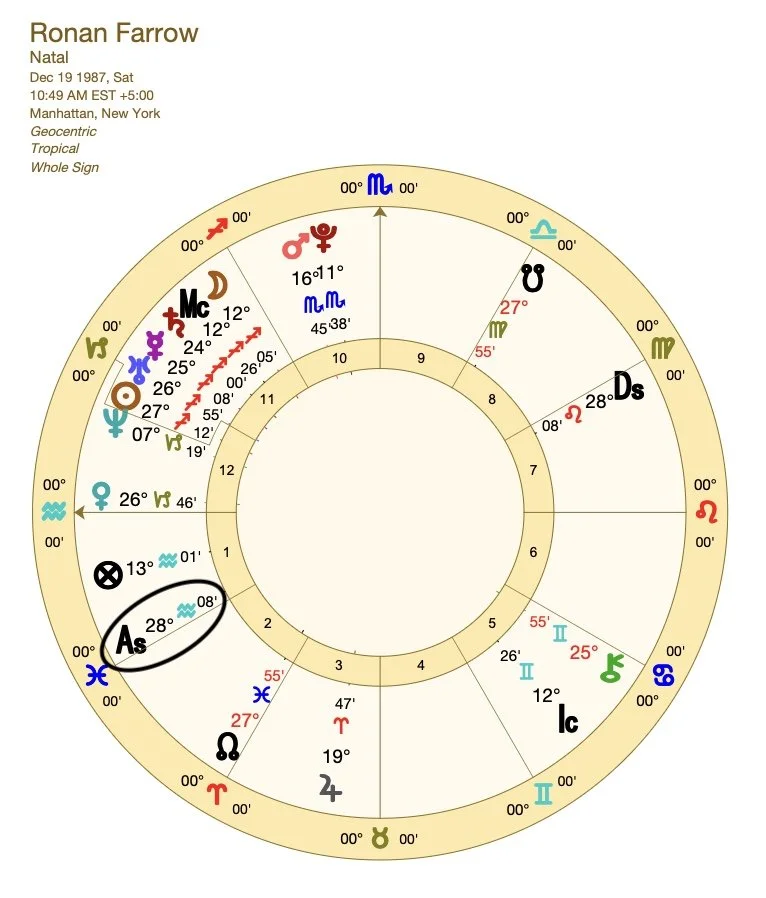
His grappling with his ideals around this topic is rooted in his own family history. Remember, the Moon and Venus are the decanic rulers, and the Moon relates to our embodied existence in this lifetime. He had a sister, Dylan, who accused their father, Woody Allen, of sexual abuse, and Ronan Farrow supported her. This became the path he chose in his investigative journalism—examining sexual abuse within the entertainment industry.
This illustrates the larger theme: we are not bringing forward just any ideal. We are bringing forward an ideal rooted in our own history—something that draws us back into the world and compels us to express it.
The final piece I want to highlight is the capacity for strategic decision-making in presenting new ideas to the world. We see this clearly with Ronan Farrow. In his investigative journalism, he was deliberate and strategic in how he brought his findings forward. He was challenging powerful public institutions and confronting influential men who were ultimately brought down by his reporting. He understood the need to be careful in his approach.
In the Weinstein investigation, he spent months cultivating sources, securing on-the-record testimony, and documenting intimidation before publication. He built the story methodically, anticipating legal and institutional resistance. We can see the Seven of Swords energy here—doing significant work behind the scenes before revealing it publicly. That strategic capacity is clearly reflected in his chart.
Closing
I hope you enjoyed the video. I really love making these videos because they deepen my own understanding of the zodiac. You can never go too deep. I’m a Scorpio rising, so that may explain it.
If you have additional insight into your own chart and how this energy manifests for you, I would love to hear it. The best way to learn is through people’s real, subjective experiences of the planets and points in their charts.
I’ll see you soon for Pisces I. We’re almost finished with this decan walk.