
Pisces I: Saturn’s Discipline Meets Jupiter’s Faith
In the video below, I explore Pisces I, the first decan of Pisces — a part of the zodiac that has a lot to do with the beginning of the spiritual journey. It’s often the point where we start to sense that what once satisfied us in the material world doesn’t quite reach the deeper longing underneath. There’s a turning inward here, a reassessment of desire, and a recognition that something more essential may be calling.
Pisces I carries themes of departure and discernment. It asks whether we’re willing to walk away from what is familiar, even when it still appears intact on the surface. The Eight of Cups speaks directly to this movement — the figure who leaves behind material fulfillment in search of something that can’t yet be fully named. Questions of longing, illusion, faith, and spiritual maturity are all part of this decan’s energy.
In the video, I explore the Rider–Waite tarot imagery, the combined Jupiter and Saturn rulership of this decan, and the role of Hod on the Hermetic Tree of Life. I also look at how these symbolic layers show up in lived experience through the charts and spiritual paths of Adyashanti and Ram Dass, both of whom reflect the Pisces I themes of awakening, devotion, and stepping away from worldly identity in service of something deeper.
Transcript (Revised and Expanded)
Introduction
Hi, this is Cathy Gnatek. I continue my series on the 36 decans of the Zodiac today with Pisces I, the first 10 degrees of the sign.
Pisces I has a lot to do with the spiritual seeker — and sometimes with the spiritual teacher. It’s the energy of those who feel called toward a deeper connection with the divine, and in some cases, help guide others toward that same source — that which sustains and supports us.
This energy often emerges when chaos hits our life, or when we realize that the vicissitudes of life can feel like too much. It’s the moment when we want to turn inward and find a resource that can provide equanimity during times of difficulty.
We see that the Eight of Cups tarot card, which closely resembles the Hermit in the Major Arcana, is associated with this part of the zodiac. It represents a turning away from what sustains us in the material world and a movement toward the divine. That is the very beginning of Pisces as a sign, and in the Hermetic Kabbalah this is reflected in Hod.
The number eight, or the eighth sephirah, is associated with this decan, and I’ll speak more about that. I’ll also share a couple of examples of people who have prominent planets in this part of the zodiac — Adyashanti, a well-known non-dualistic teacher, and Ram Dass, another spiritual teacher.
I hope you enjoy the video. If you do, please like and subscribe. I’m working to grow my channel right now, and I truly appreciate your support. I’ll begin by talking about the sign of Pisces and the myth associated with it to ground us in Pisces energy.
Myth of Pisces
Pisces, the constellation, is depicted as two fish bound together. In Greek mythology, these fish are associated with Aphrodite, the goddess of love, and her son Eros. The story tells us that when the monstrous Typhon rose up and threatened the gods, creating chaos and upheaval, Aphrodite and Eros fled to escape him.
Typhon was not a minor figure — he was described as a terrifying, serpentine force of destruction who challenged Zeus himself and threatened the cosmic order. So this was a moment of real chaos.
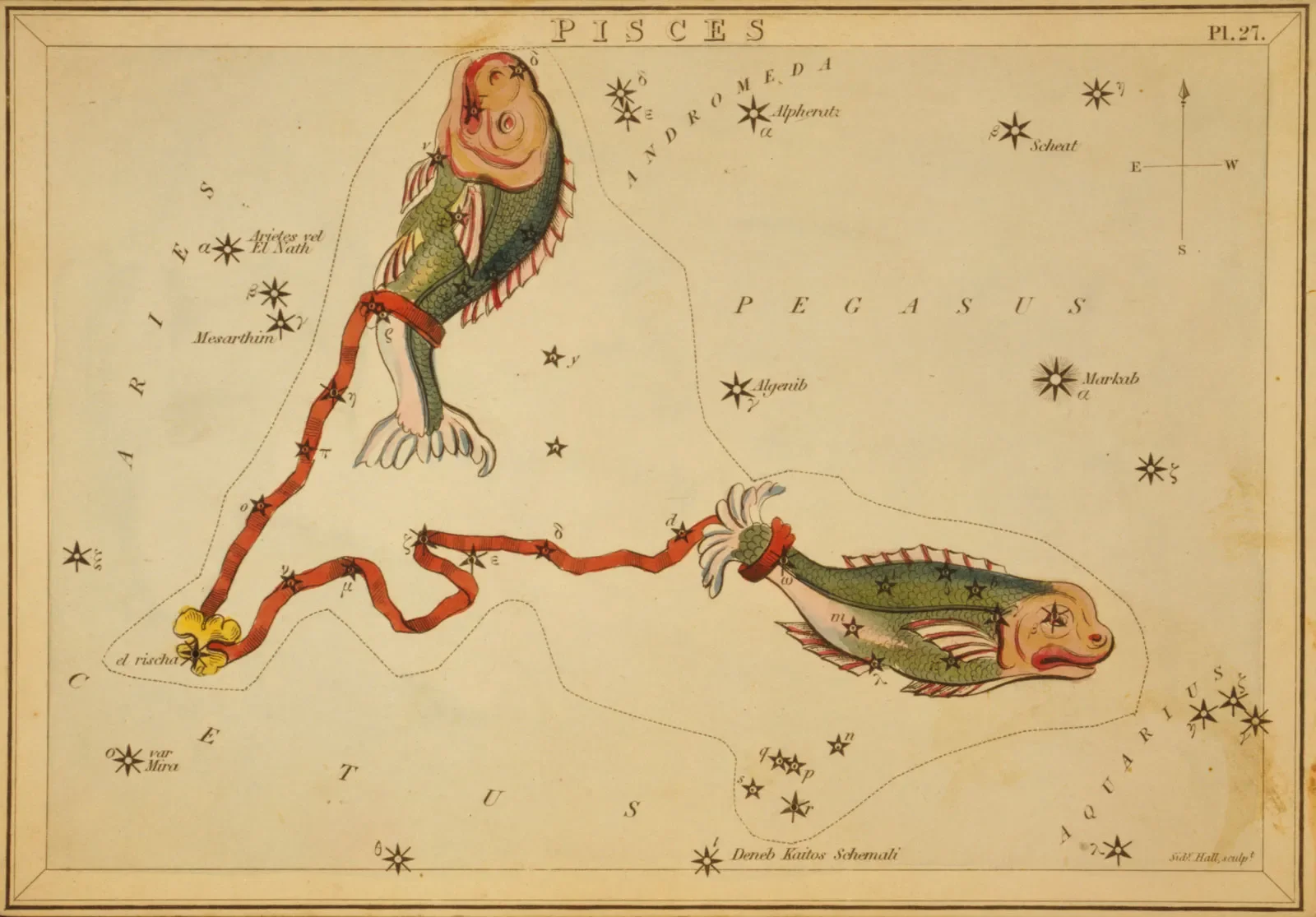
To escape, Aphrodite and Eros leapt into the river. In some versions of the myth, they transformed themselves into fish; in others, two fish carried them to safety. To make sure they would not lose one another in the rushing waters, they tied themselves together. That image — two fish bound by a cord — is what becomes the constellation Pisces.
After Typhon was defeated, the fish were placed in the sky in honor of their escape. So embedded in this myth is the idea of surviving chaos not by overpowering it, but by surrendering to the waters — by trusting, by flowing, by staying connected.
Symbolically, that’s very Piscean. There’s something here about letting go into the unknown, having faith in the flow of life, and trusting that connection — especially in moments when everything feels unstable.
In addition to the myth associated with Pisces, we can also look at the planet that traditionally rules the sign, Jupiter. Jupiter represents abundance, expansion, optimism, faith, trust, and generosity. It carries a warm, life-affirming energy. When we combine that with Pisces as a water sign — flowing, intuitive, emotionally deep — we begin to feel the expansive and compassionate quality of Pisces energy.
Pisces is also a mutable sign, which means it is adaptable, flexible, curious, and changeable. At its best, this can show up as a loving, open connection to something divine. But there is also a longing embedded in Pisces. Sometimes that longing to merge with the divine can feel tender or even painful for people who carry strong Pisces energy.
Decanic Rulers: Saturn and Jupiter
When we move into the decan — the first 10 degrees of Pisces, which is the focus of this video — we look not only to Jupiter, the ruler of the whole sign, but also to the planetary rulers of this specific decan. Pisces I is ruled by both Jupiter and Saturn. So while Jupiter gives Pisces its expansive, faithful, generous quality, Saturn brings something more serious and grounded to this first portion of the sign.
Saturn is the planet of restrictions, limits, the God of death, the God of what’s possible in the material world, the God who rewards commitment and hard work over a long period of time. There’s a seriousness to Saturn, and also a little bit of a heavy quality. And we see this reflected in the very notion of the tarot card associated with these 10 degrees — the Eight of Cups.
Tarot Correspondence: Eight of Cups
The card associated with these first 10 degrees is the Eight of Cups. In the image, we see a figure turning away from eight upright cups. The cups aren’t overturned; nothing is broken. There is abundance there. There is opportunity in the material world. And yet the figure chooses to walk away, moving toward a distant mountain — toward solitude, toward something deeper.
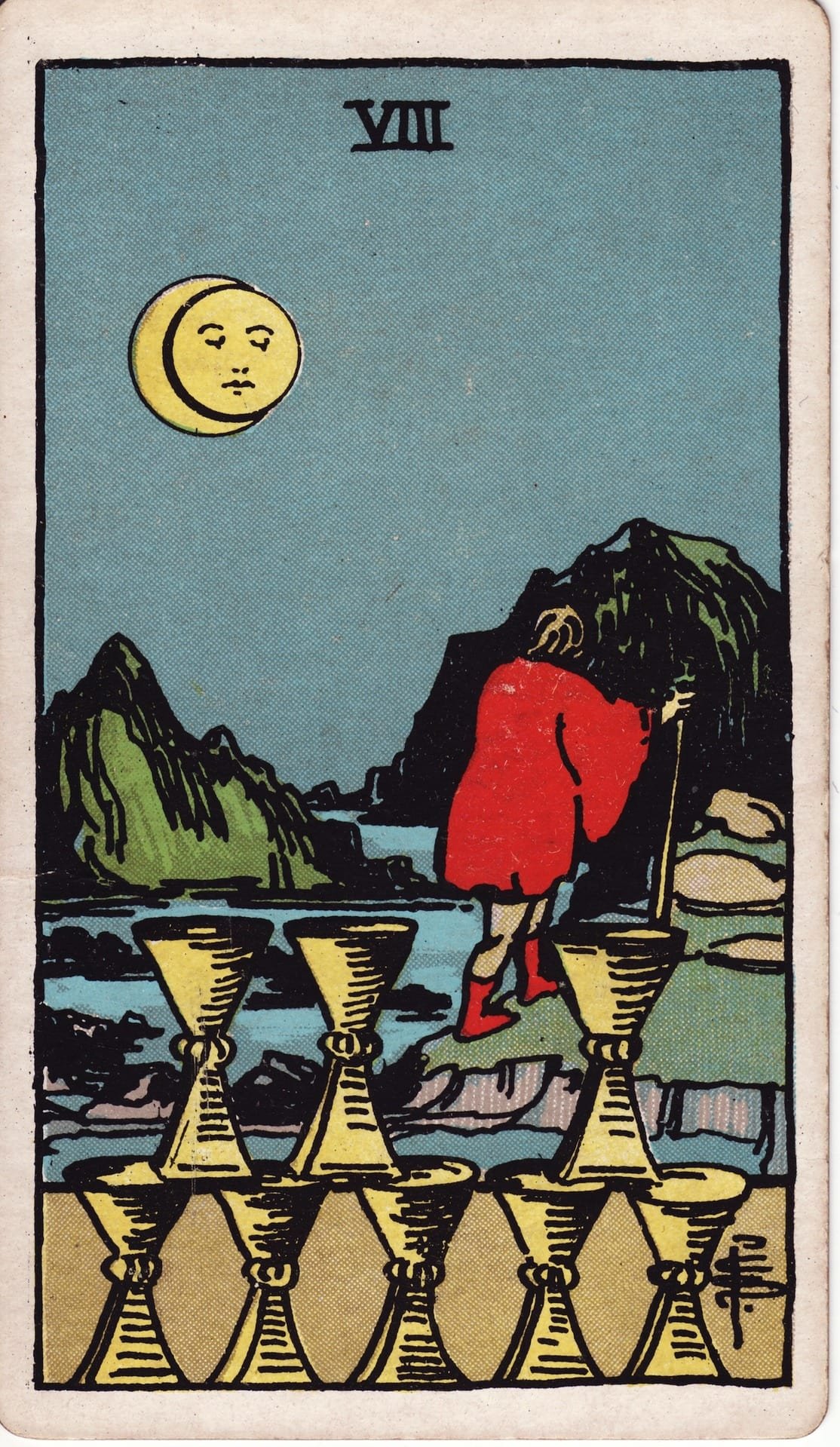
8 of Cups, Rider-Waite Tarot
That act of walking away is very Saturnian. It reflects the maturity to recognize when something is no longer enough, even if it still “works” on the surface. It’s the strength to detach and the discipline to follow an inner calling.
We see that this turning away happens under an eclipse. You can see the eclipse there on the left side of the card. Eclipses are moments of — you could say — a cosmic reboot.
Without going too far into the philosophy, an eclipse occurs when the lunar nodes align with the sun or the moon. The nodes move in what’s called primary motion, which Aristotle referred to as the motion of God — a movement that’s different from the ordinary motion of the planets. Symbolically, it represents a higher order of alignment.
So eclipses can act as moments of karmic correction. If we’ve been moving in the direction of the ego’s desires rather than the deeper desires of the soul, an eclipse can bring events that recalibrate us. Things may enter our life. Things may fall away. But the end result is realignment — bringing us back into accord with something more essential, more divine.
It pulls us out of the illusion that we’re in control. It interrupts the ego’s storyline.
And we see that same energy in the Eight of Cups — a kind of cosmic reboot moment. There’s a turning away from what the material world offers, not because it’s broken, but because something deeper is calling. It’s a correction of direction. A movement toward alignment.
Hermetic Qabbalah: The 8th Sephira, Hod
And this is where I like to bring in the Hermetic Qabbalah to deepen our understanding of the decan.
We can tell which number on the Tree of Life is associated with the decan by looking at the tarot card. This is the Eight of Cups, so we’re talking about the eighth sephira, Hod. The creators of the Rider–Waite deck were aware of Hermetic Qabbalah symbolism when they created the deck, so these correspondences are deliberate.
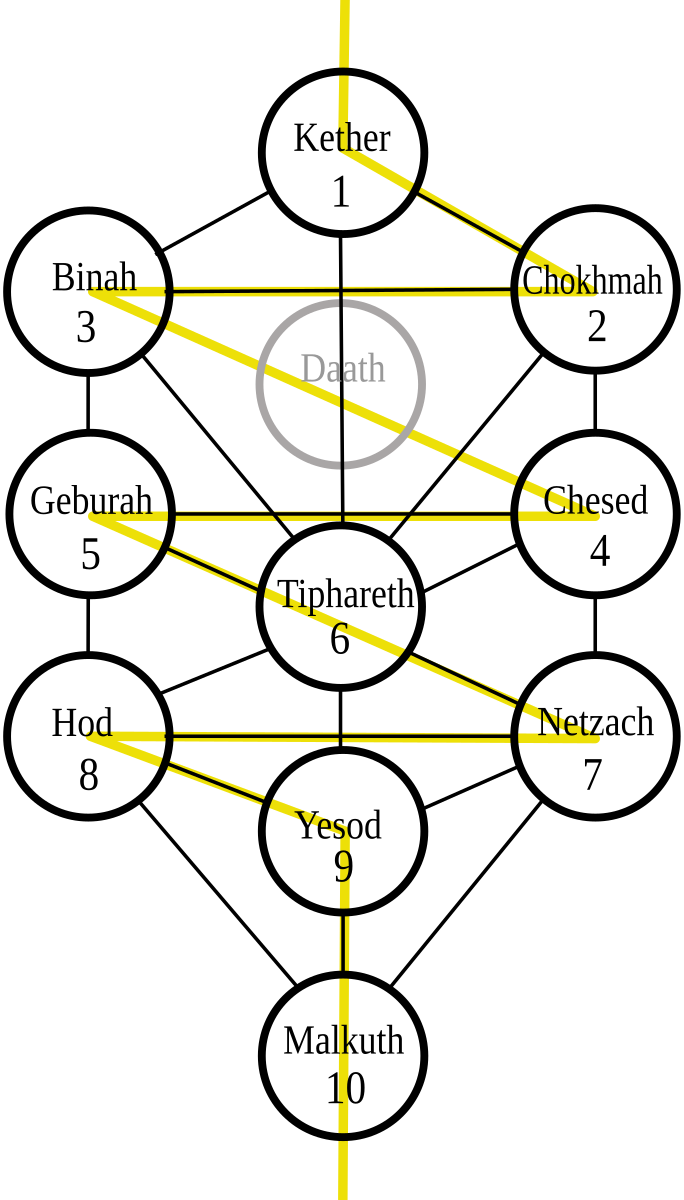
Tree of Life, Hermetic Qabbalah
So what is the Tree of Life? It’s a mystical diagram that represents the descent of divine inspiration into the material world. It’s often arranged in a way that mirrors the human form — suggesting that the same spiritual structure shaping the cosmos also lives within us.
And there’s this lightning flash that traces the flow of creative energy from divine source — Kether — at the top, down through the sephirot, all the way into the physical world at the bottom.
This process shows how spiritual concepts take form and manifest in reality, connecting the divine to the earthly realms.
When we look at Hod and Pisces I — the number eight on the Tree of Life — we see that Hod is the sphere of intellect, language, analysis, and reflection. It’s the realm where experience is processed, named, and understood.
If we think about the Eight of Cups and the first decan of Pisces, there’s something about getting distance. The capacity to observe. If you think about Aphrodite and Eros turning themselves into fish and diving into the ocean, that’s an immersion into the divine. But here, at the beginning of Pisces, there’s first a recognition.
With the Eight of Cups, something that was once emotionally fulfilling is left behind. We separate from it in order to get distance, to observe, to see what’s left when we step out of that material energy. Is there something underneath it?
Hod’s quality is discernment through understanding — the ability to step back, name loss, and choose clarity over attachment.
And in Pisces, this manifests as quiet withdrawal, spiritual reassessment, and the willingness to walk away from illusion. The very beginning of Pisces is that moment when we’re separating and beginning to observe. When we get deeper into Pisces, we’re in the water, connecting more fully with that depth. But the beginning of Pisces is the aha — the recognition that there is something else.
And that’s how you get spiritual teachers who connect people with the divine. They’re able to observe and articulate the reality of something deeper and share it with people who are at the beginning of their own path. That’s part of what we’ll see with Adyashanti and Ram Dass — that part of their function in this world is to name this energy, to identify it for people so they’re able to connect with it.
The figure in the Eight of Cups turns away from what’s been built, seeking something unnamed but necessary. This is Hod’s lesson. Wisdom sometimes requires departure, and understanding begins when we acknowledge what is no longer enough.
And we’ll see this with Adyashanti and Ram Dass as well. They both left behind pursuits in the material world for the sake of discovering and sharing this connection with the spiritual.
Scorpio III to Pisces I
So I want to connect this back and deepen our understanding of the Eight of Cups by briefly talking about the Seven of Cups, which corresponds to the last decan of Scorpio. Scorpio is the water sign that comes right before Pisces.
When we look at the Seven of Cups, we see a moment of exploring desire. People with points or planets in this part of the zodiac are often confronting all the things that seem to feed them in the material world — all the options, all the longings, all the fantasies. And the question becomes: what do these desires really mean? And how do they sometimes lead us into illusion?
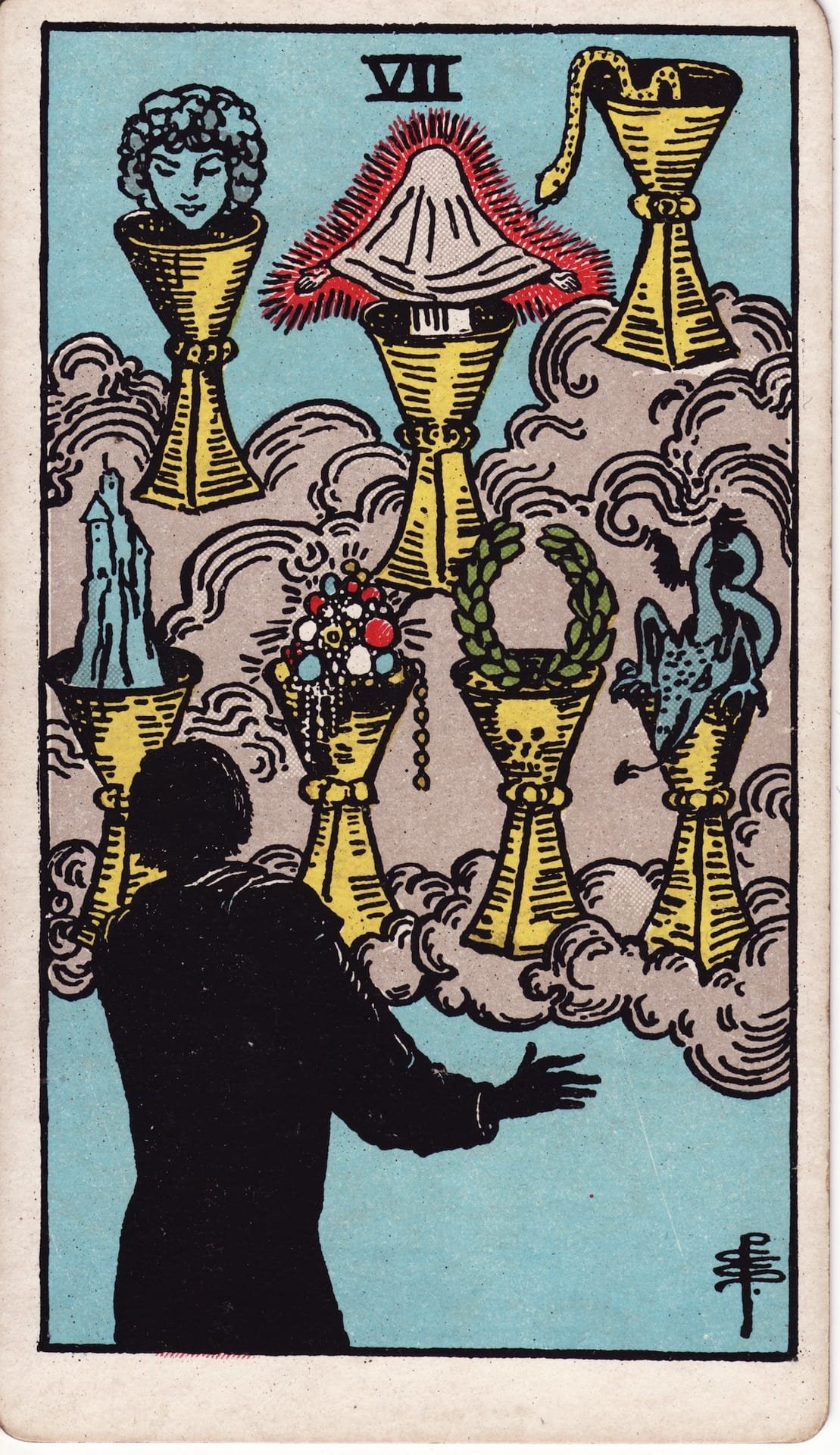
7 of Cups, Rider-Waite Tarot
On the spiritual path, there’s often an emphasis on the illusory nature of what appears to satisfy us in the outer world. That doesn’t mean desire itself is bad. It’s not wrong to want pleasure, beautiful things, good food, physical intimacy, or ambition in the world. Those aren’t the problem.
The difficulty begins when we identify with those desires as if they’re going to resolve the deeper spiritual longing. When we expect them to give us something lasting. Life is constant movement, constant flow, constant letting go — that’s what the Buddha taught. So when we move from Scorpio III into Pisces I, there’s a shift. We begin to realize that what once satisfied us doesn’t fully satisfy. There’s something deeper that wants more than just the accumulation of experiences or material fulfillment.
So we turn toward the divine.
And I know I’m repeating myself a little bit, but this is hard to explain, because when we talk about the divine, we’re really talking about the unknown. We’re talking about what becomes accessible when we quiet ourselves in meditation. When we connect to what the Buddhists call the heart-mind instead of just the intellect. When we connect to the source of love — that heart-mind awareness. When we drop down into the deeper part of ourselves, into the hara, into that grounded center below the surface personality.
There’s something there that sustains us. Something larger than the individual body. And it’s that deeper source that Pisces I begins to sense — and move toward.
Chart Example: Adyashanti (Jupiter in Pisces I)
Again, a lot of what we’re talking about here is reflected in the teachings of Adyashanti and Ram Dass. So if you have planets or points in this part of the zodiac, these might be teachers you resonate with.
Adyashanti had an awakening at the age of 25 — what he describes as more of a head awakening. It was an experience of vastness, of spirit, of connecting to something infinite. Then, around age 30, he had what he called a heart awakening. He referred to the first as “waking up” and the second as “waking down” — wakening into the body.
There’s so much I could say about his teachings. I’ve followed him for a long time. Through his meditations, he has a way of describing this deeper source that sustains us. And somehow, through the way he articulates it, it becomes physically accessible. It’s hard to explain, but there’s a way of connecting with that sustaining energy that becomes embodied.
So I offer that if you’re interested in exploring this more.
Adyashanti also has Jupiter in Pisces. Since Jupiter rules Pisces, that gives him an added strength and capacity to articulate this loving, abundant, expansive energy that he points to.
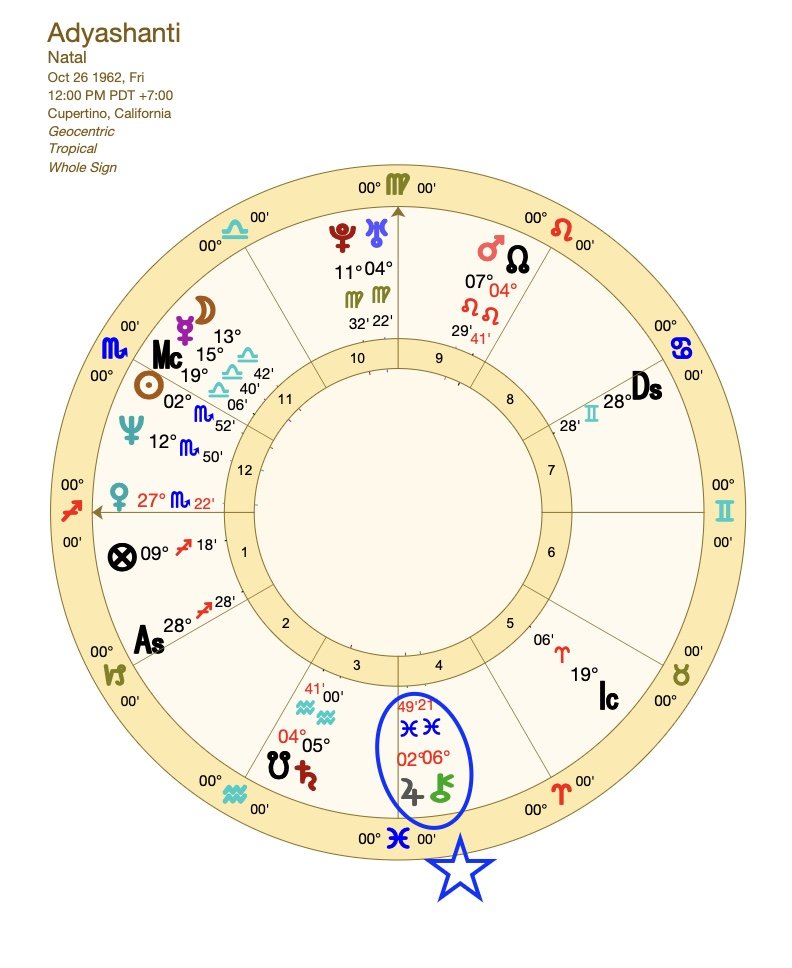
Something else that’s interesting about him: he began primarily as a non-dual teacher. And sometimes non-dual teachings can feel like they leave the body out of the equation. But later in his life, he went through significant physical suffering and health challenges. And that experience deepened his teaching. It brought him into a more embodied spirituality — emphasizing not just transcendent awareness, but presence within the body. Being present to pain. To vulnerability. To the lived human experience. And discovering that support is available even there.
That piece feels important in the context of Pisces I.
Now, just as an aside — I have Saturn in this decan of Pisces. Wherever we have Saturn in our chart is often where we come into the energy more slowly, over time, through effort and discipline. I recently went through my second Saturn return in this decan, and my experience has been that it brought me into a much more committed meditation practice — a disciplined commitment to connecting with something deeper than myself.
If Jupiter gives expansion and articulation, Saturn — which also rules this decan — gives fortitude. It gives the strength to commit to practice over time. For me, that didn’t really solidify until my 50s. But once it did, it stuck. That’s Saturn.
And you see that same long-term commitment to practice in both Adyashanti and Ram Dass.
Chart Example: Ram Dass (Venus in Pisces I)
To finish with Ram Dass — another teacher I deeply resonate with — he has Venus in this decan of Pisces. And Venus is exalted in Pisces. Venus is the goddess of love.
Ram Dass’s spiritual path didn’t begin in a monastery. He was a Harvard professor experimenting extensively with psychedelics — hundreds, maybe thousands of LSD experiences, exploring altered states as a way of expanding consciousness.
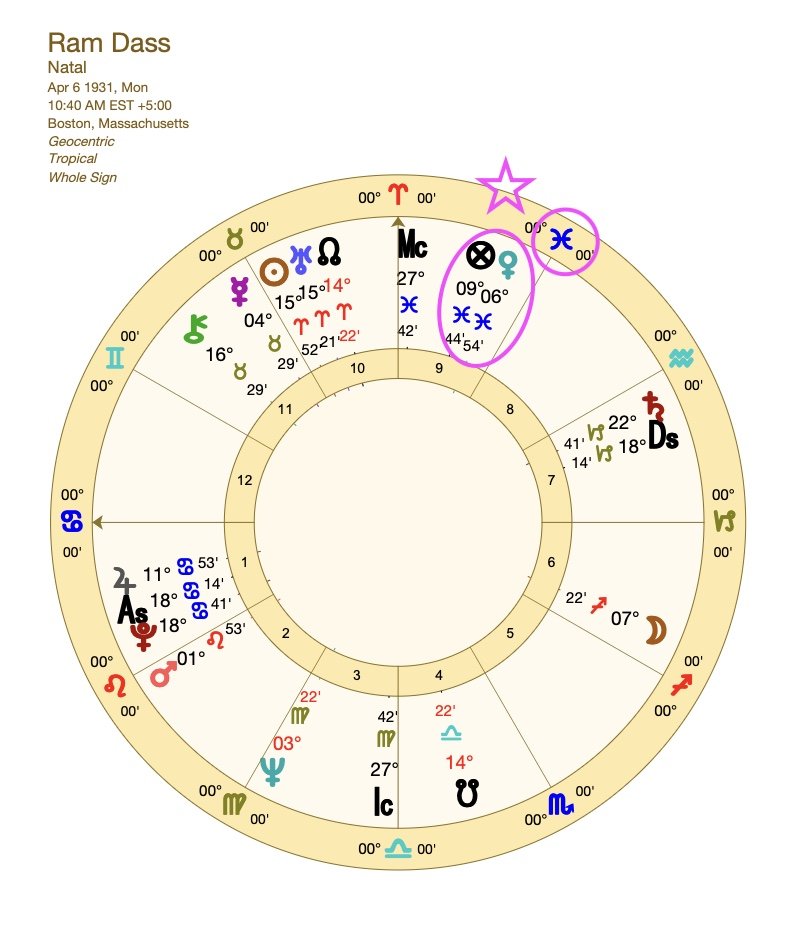
Eventually, he traveled to India and met his teacher, Neem Karoli Baba — whom he called Maharaji. If you read his biography, he describes meeting Maharaji and simply falling in love. After all the psychedelic experiences, it wasn’t the drugs that brought awakening. It was love. It was being in the presence of his teacher.
Ram Dass went on to teach and founded the Love Serve Remember Foundation. And love became central to his message.
Like the figure in the Eight of Cups, he walked away from material abundance and status. He came from wealth. He achieved professional prestige. And he left it behind — or perhaps it fell away — when he was fired from Harvard. But even that was part of the turning. Part of walking away from the world that had defined him.
His biography also shows how much of his path involved working through desire, confronting attachment, and letting go. Which brings us right back to the movement from the Seven of Cups into the Eight — from exploring desire to recognizing that something deeper is calling.
So that was a lot. But I have to say, this is one of my favorite decans — especially lately. It’s been a big one for me personally.
I hope you enjoyed the video. If you did, I’d love it if you liked and subscribed. And I’ll see you soon as we explore Pisces II. Thanks.