
Capricorn II: Shaping Creative Force Responsibly
Dreamstime.com
In the video below, I explore Capricorn II, the second decan of Capricorn and the part of the journey where effort begins to take structured form. This is the decan where building becomes deliberate and coordinated, often involving other people, shared goals, and long‑term planning. Capricorn II focuses on creating something that can endure, rather than simply initiating action or responding to immediate pressures.
At its core, Capricorn II deals with collaboration, structure, and the shaping of effort through understanding. The Three of Pentacles captures this clearly: work is done within a plan, roles are defined, and success depends on cooperation rather than individual effort alone. This decan raises questions about how force is organized, how responsibility is shared, and how meaningful work takes shape over time within limits.
In the video, I look at the Rider–Waite tarot imagery, the Saturn, Venus, and Mars rulerships, the role of Binah on the Tree of Life, and how these themes manifest in real life. I also examine the chart of Paul Newman, whose career and philanthropic work reflect Capricorn II themes of collaboration, sustained effort, and building something that serves a broader purpose.
Transcript (Revised and Expanded)
Hi, this is Cathy Gnatek. I continue my series on the 36 decans of the zodiac today with Capricorn II, the second ten degrees of the sign. We’re going to see that people with points or planets in this part of the zodiac tend to be builders of the world. These are people who often focus—sometimes in cooperation or collaboration with others—on creating a significant work, something that takes time, coordination, and sustained effort.
We see this theme clearly reflected in the tarot card associated with this decan, the Three of Pentacles. One of the central questions that comes up here is: What are we building, and what is motivating that effort? Are we building out of a survival impulse? For example, “I’m going to create this massive cathedral so that my name lives on, because I’m afraid of death.” From a psychological perspective, that kind of fear-based motivation can underlie ambition. Or is the ambition centered more on the creative force itself—on wanting to participate in the act of shaping something that has meaning beyond the individual?
That distinction matters for this decan. Capricorn II is not just about ambition or productivity, but about how and whysomething is constructed, and whether the effort is aligned with something larger than personal survival or recognition.
We’re going to see this idea of channeling life energy more clearly when we look at the Kabbalah and the sephira associated with this decan in a moment.
Focusing more specifically on the second decan of Capricorn, in addition to Saturn ruling the sign as a whole, we have two decanic rulers. The first is Venus, the goddess of love, attraction, harmony, beauty, art, pleasure, values, and relationship. Venus describes how we receive energy, how we attract resources, people, and opportunities, and what we value enough to commit ourselves to over time.
The second ruler, under the Chaldean order, is Mars. Mars represents outward drive, action, assertion, courage, and will. It is the energy that pushes forward, that initiates effort, and that takes risks in order to accomplish something. Mars can also bring conflict, but at its core it is the engine of directed action.
When you combine Saturn with Venus and Mars in an earth sign, you get a very specific dynamic. Saturn asks for endurance, discipline, and long-term commitment. Venus brings value, attraction, and the capacity to cooperate with others. Mars supplies the will and momentum to act. Together, these rulers describe the ability—and sometimes the pressure—to build something tangible, enduring, and socially relevant.
This is a decan associated with people who construct systems, institutions, works, or structures that take time to develop and often require collaboration. Saturn prefers projects that last. Venus helps align the effort with shared values or collective appreciation. Mars provides the stamina to keep going when the work becomes difficult.
We also see that there can be an elevated goal here, sometimes approaching a spiritual or philosophical dimension. This is not necessarily about spirituality in a devotional sense, but about channeling something larger—whether cultural, social, or symbolic—into form. That idea is present in the Three of Pentacles.
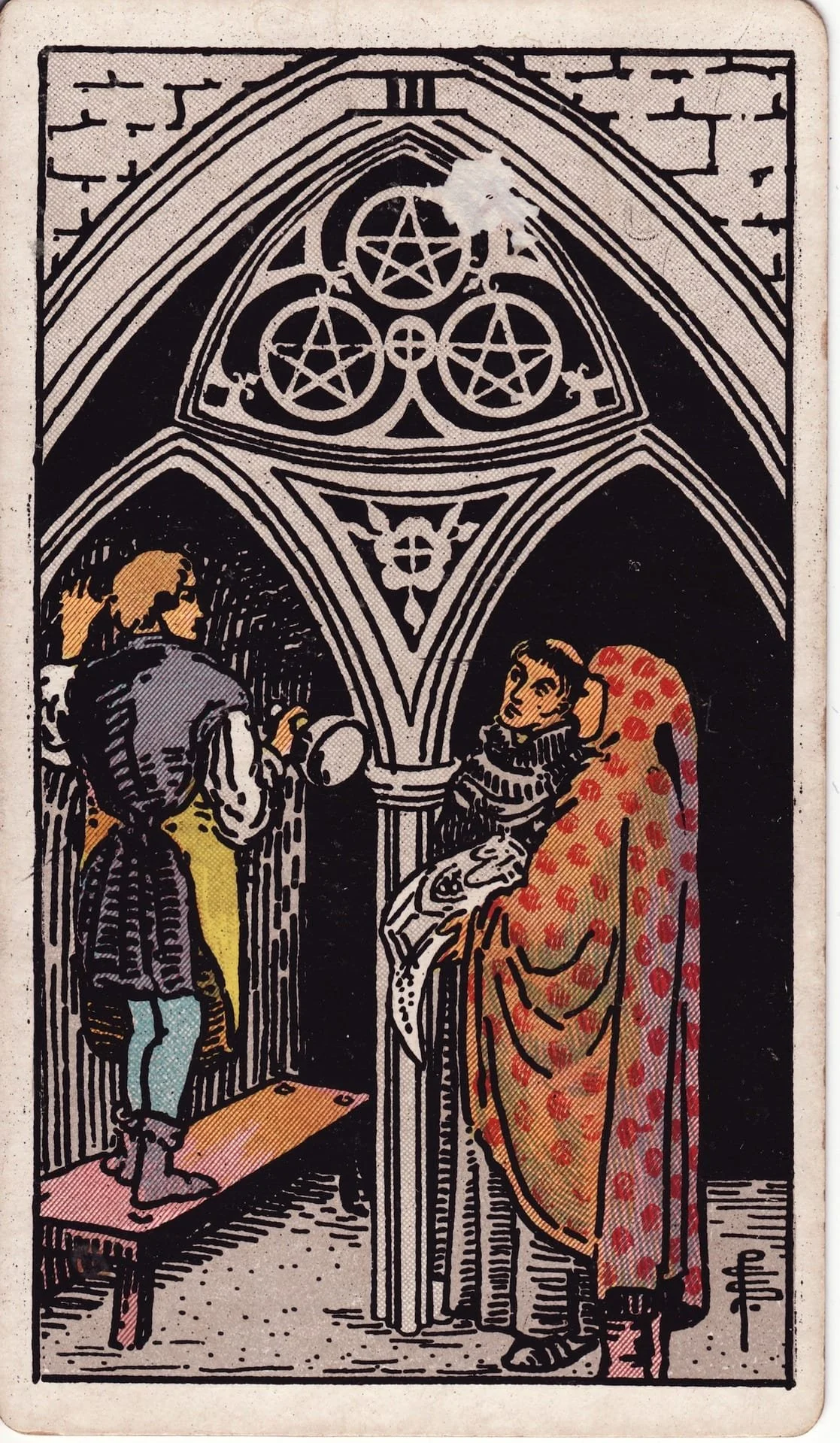
In the Three of Pentacles, we typically see three figures: a planner or architect holding the design, a craftsperson executing the work, and often a monk or religious authority overseeing the project. This suggests not only technical skill, but also planning, vision, and alignment with a larger framework or purpose. The number three implies coordination. It is not a solitary effort, but one that requires roles, communication, and agreement.
Make it stand out
3 of Pentacles, Rider-Waite Tarot
One detail I’ve always found interesting about this card is the depiction of the pentacles themselves. Unlike most cards in the suit, the pentacles here are not shown as solid coins. Instead, they appear as hollow or outlined forms. If you’re familiar with philosophical traditions that emphasize emptiness or negation—such as Buddhism—you might interpret this as a recognition of limits. The work is not about glorifying the ego. The individual is not the final product.
There’s an implication that the builder is participating in something that extends beyond personal identity. The structure may endure longer than the person who builds it. That idea aligns closely with Capricorn II: contributing effort to something that may outlast the individual, and accepting that role without needing full ownership or recognition.
Now we can look at a couple of ancient sources that further develop this theme. I chose the Yavanajataka for this decan, in part because it emphasizes large-scale social structures. Austin Coppock notes that this decan relates to projects that are not minor or temporary. These are efforts that require sustained coordination and that serve a broader collective function, whether social, cultural, or institutional.
The second source is Agrippa, who describes Capricorn II as “two women and a man looking toward a bird flying in the air.” The signification he gives is “the requiring of those things which cannot be done, and the searching after those things which cannot be known.” This points to the aspirational side of the decan. Mars is exalted in Capricorn, which can create a strong drive to attempt something difficult or ambitious.
At the same time, Saturn’s rulership reminds us that not everything is possible. There is a tension here between aspiration and limitation. This decan often involves learning where human effort can be applied effectively, and where limits must be acknowledged. Overreach is possible, particularly when Mars pushes beyond what Saturn can realistically sustain.
Another key theme is collaboration. The Three of Pentacles is explicit about this. Assistance from others is not optional here; it is part of how the work succeeds. This decan often requires cooperation between people with different roles or areas of expertise. We’re going to see this reinforced when we look at the Tree of Life.
The Qabbalistic Tree of Life represents the descent of divine or creative inspiration into the material world. Energy flows from Kether, number one, down through the lightning flash to Malkuth, number ten, where manifestation occurs. This diagram shows how abstract potential becomes concrete form.
For Capricorn II, we look at the number of the tarot card, which is three, and associate it with Binah. This marks the movement from Chokmah (number two) to Binah (number three). Binah is associated with understanding, structure, containment, and form. It sits on the Pillar of Form and corresponds to the Great Mother.

Make it stand out
Tree of Life, Hermetic Qabbalah
If we think again about building a cathedral in medieval times, Binah makes sense. These projects required planning, patience, and continuity across generations. Work might pause and resume depending on resources, politics, or war. The structure emerged slowly, shaped by understanding rather than force alone.
In the Three of Pentacles, the figures work within a defined architectural framework. This illustrates Binah’s principle: creation becomes sustainable only when raw force is shaped by understanding. Chokmah provides the impulse; Binah provides the structure.
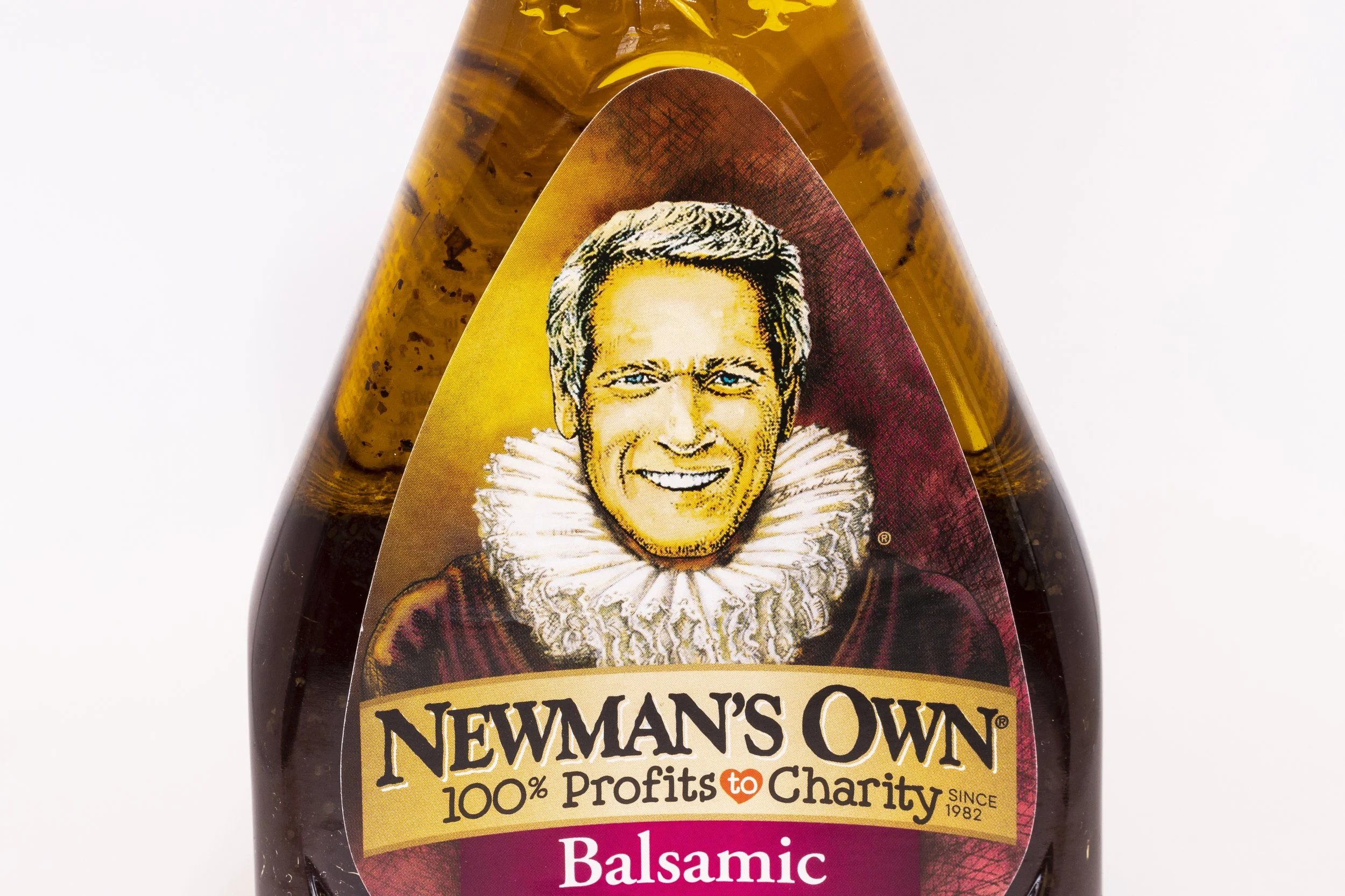
To ground this in a real-world example, we can look at Paul Newman. He was known as an actor who collaborated well with others, which reflects the cooperative nature of this decan. Beyond acting, he built a business around food products—pasta sauce, popcorn, and others. Importantly, the majority of the profits were donated to charity. This reflects Capricorn II’s capacity to build something substantial while orienting the effort toward a collective or social purpose.
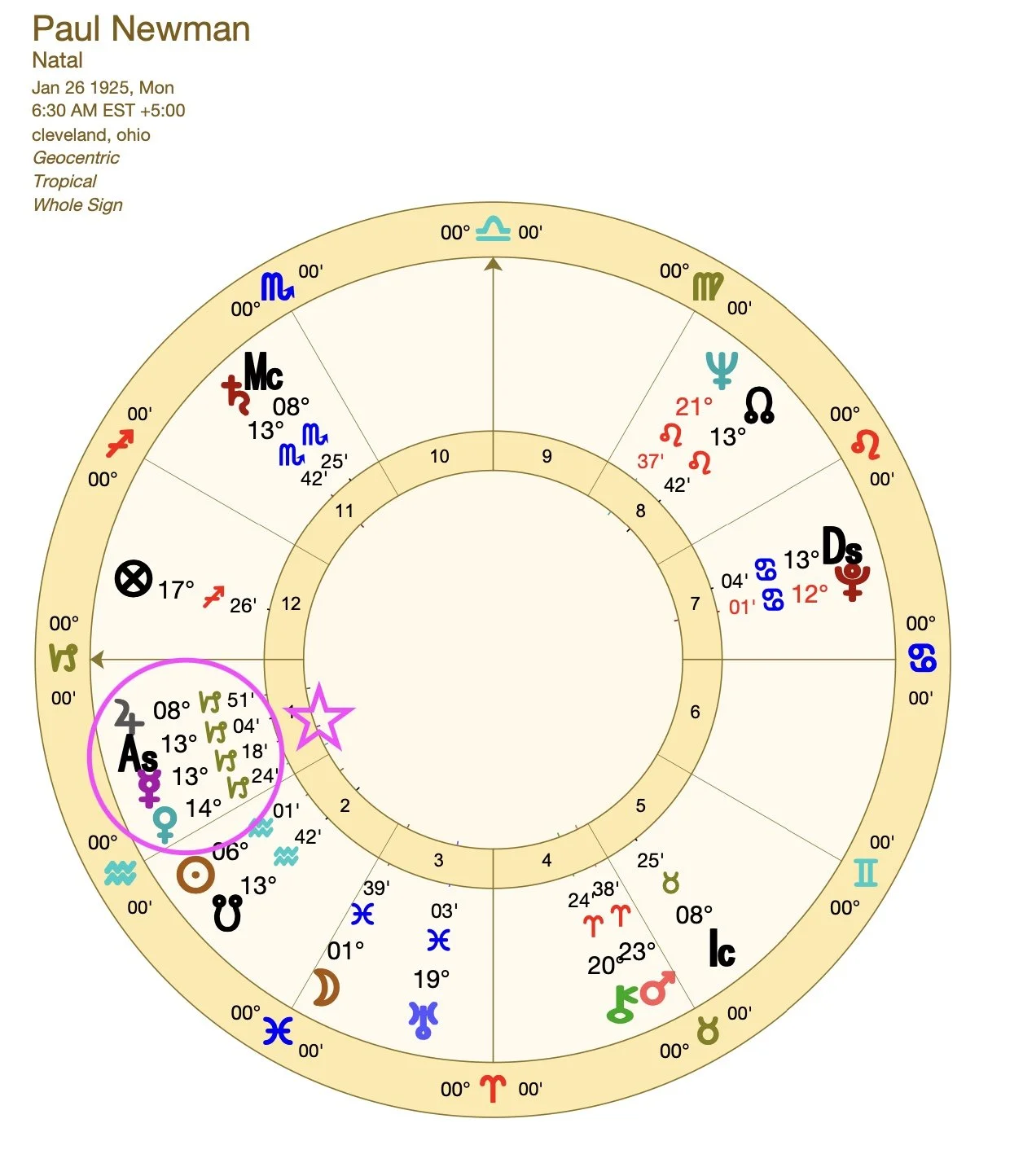
One final detail worth mentioning is his chart. Paul Newman had Mercury conjunct the Ascendant, with Venus and Jupiter also close to the Ascendant. Venus and Jupiter are benefics, and their placement in the first house often correlates with being well received by others. The rising sign and first house can reflect how someone is perceived, and Venus there can be associated with attractiveness and approachability.
So I hope you enjoyed the video. I’ll be back in a few days with Capricorn III. Have a great day.