
Capricorn I: Riding the Ups and Downs of Change
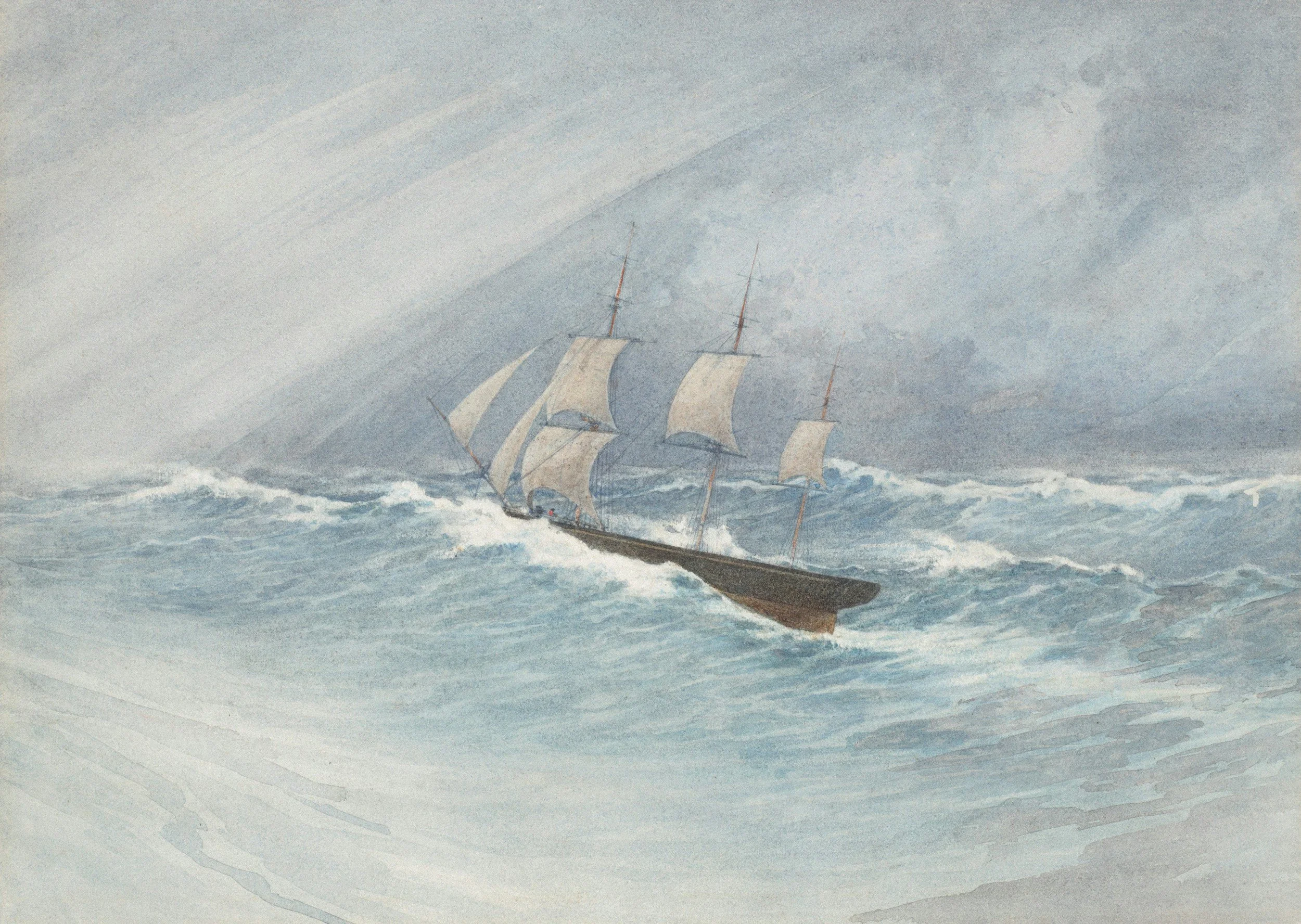
In the video below, I explore Capricorn I, the first decan of Capricorn and the part of the journey where movement begins in the material world. This is where responsibility shows up early, often before things feel settled or secure. Capricorn I is about starting to build while adapting to conditions that keep changing.
At its core, Capricorn I deals with balance, adjustment, and managing effort over time. The Two of Pentacles captures this clearly: the figure who keeps things in motion, responding to ups and downs rather than expecting stability. This decan raises questions about endurance, responsibility, and how we stay engaged when life requires constant recalibration.
In the video, I look at the Rider–Waite and Thoth tarot imagery, the Saturn and Jupiter rulerships, the role of Chokmah on the Tree of Life, and how these ideas show up in real life. I also examine the chart of Francis Ford Coppola and the character of Michael Corleone, both of whom reflect Capricorn I themes of adaptation, risk, leadership, and long‑term responsibility.
Transcript (Modified and Expanded)
Hi, this is Cathy Gnatek. I continue my series on the 36 decans of the zodiac today with Capricorn I, the first 10 degrees of the sign. People with points and placements in this part of the zodiac have an uncanny ability to adapt to change in life. They ride the waves, as we’re going to see in the tarot card, the Two of Pentacles. In the background of that card, you see a ship going up and down on the waves, and this really exemplifies the reality of the energy of this part of the zodiac. There’s something that is always changing, and there is a need to adapt in a responsible way.
We’re going to see that responsibility is a big theme here, because Saturn rules the sign as well as the decan. Then the idea of expansion, change, and constant movement comes from Jupiter, which also rules the decan. I’ll bring in the tarot card, the Two of Pentacles in the Rider-Waite deck, as well as the Two of Disks in the Thoth deck, which is called Change. We’ll also talk about some ancient wisdom from texts that help flesh this energy out. Of course, I’ll bring in the Hermetic Qabbalah as well. Then I’ll finish off with an example from real life.
Francis Ford Coppola, who directed and co-wrote the screenplay for The Godfather, has his rising degree here. We’ll learn how he has had a lot of ups and downs, particularly financially, in his life. That can be part of the energy of this particular sign because it is an earth sign, which has to do with what we can accomplish in the material world. So there’s a lot to talk about. If you enjoy the video, it would be great if you could like and subscribe. I’m trying to grow my channel right now.
So let’s start off by talking about the sign of Capricorn so we can ground ourselves in the general energy of the sign. Symbolically, Capricorn is the sea goat, half goat and half fish. There’s some mythology around this sea goat involving Pan, who transforms himself into this sea goat to escape Typhon, the primordial monster of chaos. So already we get a sense that there can be something a little chaotic about Capricorn energy, or at least a desire to frame chaos. It’s like Capricorn wants to take chaos and form it into structure, and that’s part of the general background of the sign.
The symbolism of Capricorn, because it combines the goat with the fish, helps us understand this. The goat represents the steady climbing energy toward ambition that can come with Capricorn, and the fish tail has to do with instincts, instinctual energy, and chaotic emotions. There’s an attempt to work with those instincts and form something concrete in life. This points to the idea of uniting emotional memory and survival instinct with strategic restraint. Progress is earned through patience, responsibility, and sustained effort rather than speed or impulse.
Of course, we see this because the planet that rules the sign as a whole is Saturn. Saturn is the last planet we can see with the naked eye. It’s about restrictions, boundaries, and what’s possible in the material world. Saturn rewards hard work over a long period of time when it’s handled in a consistent way. Capricorn is also an earth sign. All earth signs have to do with the material world and what’s possible there. Capricorn adds ambition because it’s a cardinal sign. Cardinal signs like to start things. When you take that cardinal energy of beginning and combine it with earthy building in the world and Saturn’s restrictions, you get this drive to achieve something. I always describe Saturn by saying you can think about standing on the planet Saturn and looking back at the Earth and asking, what can I build there? That’s very Capricornian energy.
When we get into this particular 10 degrees of the zodiac, the first 10 degrees of Capricorn, we can look at the decanic rulers under the triplicity system. It’s Saturn again. Under the Chaldean order, it’s Jupiter. So we have this Saturn–Jupiter combination. Whenever you have a Jupiter–Saturn conjunction, it can feel like a new kingdom coming into being, and that’s helpful to keep in mind here.
Then we can look at the tarot cards associated with this decan. First, we see the Two of Pentacles in the Rider-Waite deck. This is one of my favorite cards. I have my Moon in this decan, and I really resonate with the adaptability shown in the Two of Pentacles. We see the infinity symbol looping around two pentacles, and a figure shifting their weight from one foot to the other. There’s a sense of juggling, but not in a frantic way. It’s more about staying responsive and flexible. In the background, and this is really important, we see the waves and the ships riding them up and down. This reinforces the idea of constant movement and flux, and the need to adjust to the ups and downs of life. The card speaks to managing multiple demands at once and learning how to stay balanced while things are in motion.
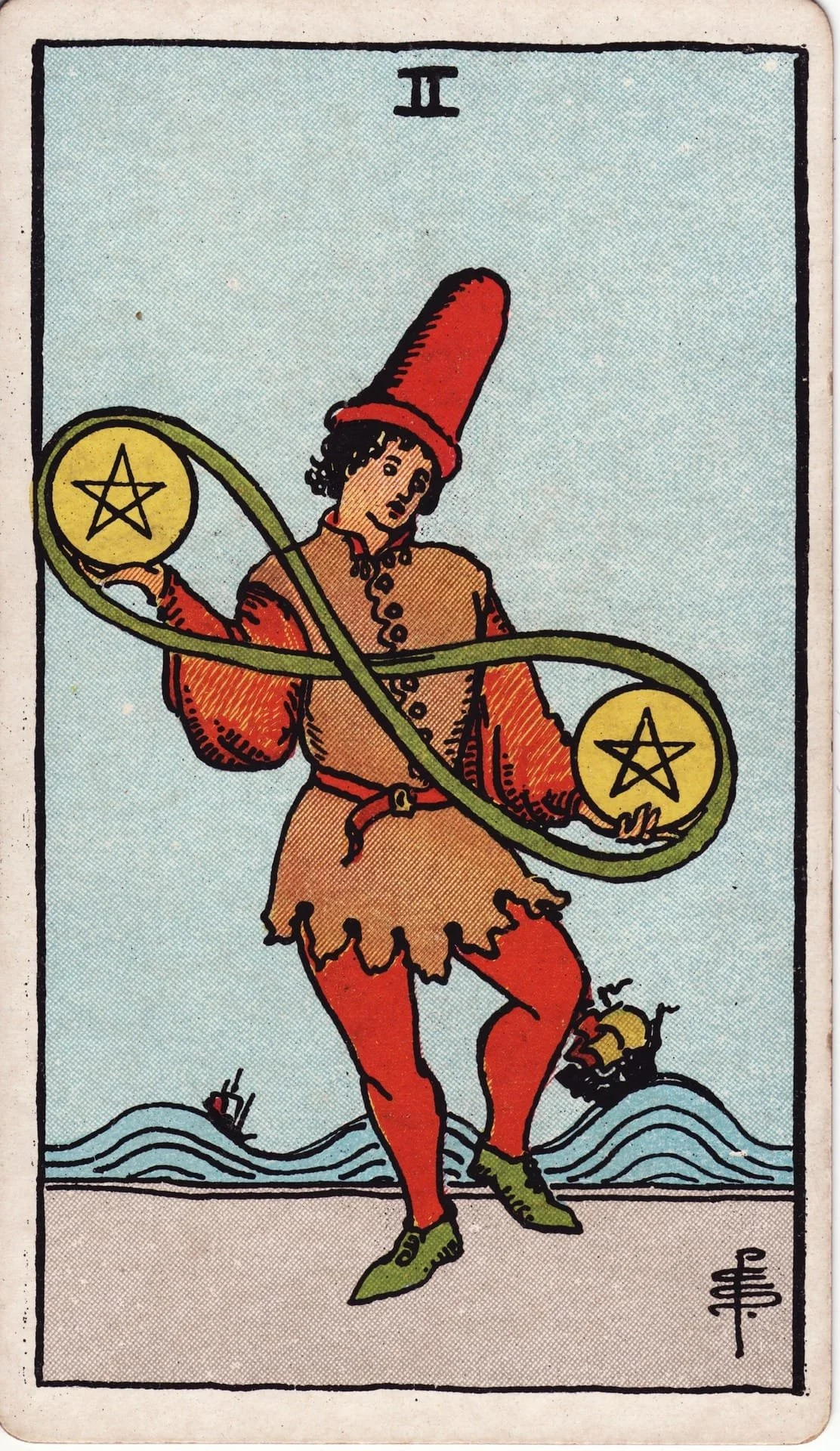
2 of Pentacles, Rider-Waite Tarot
Rachel Pollack describes this card as an initiation into material life, which I really like. Pentacles and earth signs are all about materiality and what we can create in the world. There’s an understanding here that balance doesn’t come from choosing one thing over another, but from keeping things in motion and learning their rhythm. Adaptation is key, and that’s very much part of the energy for people with points and placements in this part of the zodiac.
I don’t always bring in the Thoth card, but I had to here. In the Two of Disks, called Change, we again see the infinity symbol and two interlocking disks, encircled by a serpent, the ouroboros. There’s a strong sense of the ongoing movement and instability of life, but also of containment. You can see the yin-yang symbols and the crown resting on top, which brings to mind that Saturn–Jupiter conjunction again, the idea of a new reign or order coming into being. There’s something here about containing the chaos of life in order to create something, and riding waves of change so that the movement itself becomes part of how something is built in the real world.
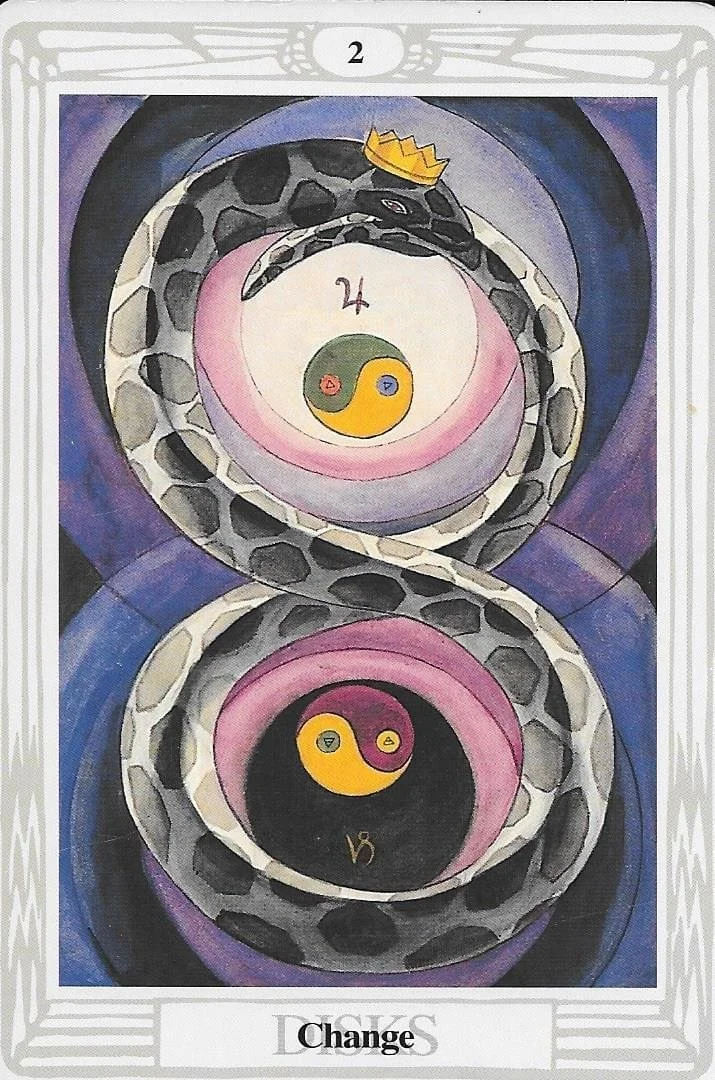
2 of Discs, Thoth Deck
This interaction between force and form is something we’re also going to see when we look at the Qabbalah. There’s energy coming into the world, and then there’s the work of manifesting and channeling that energy, even when it knocks you down or forces you to adapt along the way.
Now we can look at a couple of ancient texts. I usually pick two, and in this case Ibn Ezra didn’t really fit, but when we look at the Picatrix and Agrippa, we see similar ideas about the ups and downs of life. In the Picatrix, we have the image of a man holding a pipe in his right hand and a hoe in his left hand. It’s described as “a face of happiness, joy, and the scattering of tasks and laziness, with weakness and unceasing evils.” I see this description as capturing the highs and lows that can be part of this decan. You get the expansive energy of Jupiter, that surge of energy into the world, and then Saturn brings restriction, difficulty, and limits. So there’s a real dichotomy here. On one side, happiness and joy, and on the other, weakness and ongoing challenges.
We see this clearly in the life of Francis Ford Coppola. He experienced real financial highs and lows. He would create these films, make a lot of money, lose it, declare bankruptcy, start over, and then go through the process again. He kept going.
Then when we look at Agrippa, it fits his life even more clearly. Agrippa describes this decan as “a woman and a man carrying full bags,” and says the signification is “to go forth and to rejoice, to gain and to lose with weakness and baseness.” I’m not sure about that last part, about weakness and baseness, but the idea of gain and loss, of rejoicing at times and being brought low at others, is very much part of the energy of this decan.
The last source I want to look at is the Hermetic Qabbalah’s Tree of Life. And we’re going to see that Chokmah is the Sephira associated with this decan. But first, just a reminder. The Tree of Life is this mystical diagram that represents the descent of divine inspiration into the world. It has a lightning flash that traces the flow of creative energy from the divine source, Kether, at the top, to the physical world, Malkuth, number 10, at the bottom. This process illustrates how spiritual concepts take form and manifest in reality, connecting the divine and earthly realms.
Here we’re at number two, right near the top of the Tree of Life, where there is this primal outpouring of force on the Pillar of Mercy, the realm of dynamic movement, expansion, and directed power. This reminds me of that Jupiter energy of expansiveness that then needs to be channeled into the real world by Saturn through effort and hard work. Moving from number one, Kether, which is the sort of nothingness of the universe, to Chokmah, number two, describes the shift from pure undifferentiated potential, what you could call chaos, into active expression. Kether is the still point of origin, the seed of all possibility, while Chokmah is the first motion outward, the moment when intention becomes momentum. And remember, this is a cardinal sign, Capricorn, so we’ve got that “I’m going to begin something” energy built in.

Tree of Life, Hermetic Kabbalah
We can connect this directly to the Two of Pentacles, where we see material potential begin to move, that initiation. Two is the first number of the suit of Pentacles, so it has this initiatory quality, learning how to create something in the material world, Pentacles being that earthy energy. At this point, material potential is no longer static. Resources must be actively balanced, circulated, and managed. We see this again with Francis Ford Coppola, where a large part of his work involved finances, losing money, gaining money, figuring out how to use money to create things, and circulating money in the world. Again, Pentacles, Earth.
Chokmah’s quality is motion without containment, the raw surge of force before structure appears. In Capricorn, this motion is disciplined, but demanding, requiring adaptability and responsibility. In my own life, having my Moon here, I really resonate with this. There can be an exhausting quality that comes from the need to constantly reframe and adapt to change. I just want to name that for folks who have points or planets here. It can feel like hard work, because Saturn demands effort over a long period of time in order to take that expansive energy and actually create something with it.
So, to flesh that out a bit more, the figure in the Two of Pentacles is juggling the first real expression of material power. It’s the first of the suit, learning how to keep opposing demands in motion without collapse. That’s very Chokmah. Once force is released into the world, it has to be carried forward with conscious engagement. That’s the Saturnian piece, the sense of “I need to take this seriously.” We’re going to see this again when we talk about Michael Corleone. I’m not only going to talk about Francis Ford Coppola, who directed and co-wrote the screenplay for The Godfather, but I’m also going to briefly talk about the character Michael Corleone, one of the main protagonists in the film, who also expresses the energy of the first 10 degrees of Capricorn.
First, though, I want to explain a bit more about who Francis Ford Coppola is. I’ve already mentioned that he directed The Godfather, as well as Apocalypse Now and a number of other films. He has his rising degree here. Let me just find my pointer. There it is. You can see his Ascendant at seven degrees of Capricorn, conjunct Mars. Mars is exalted in Capricorn, which is why I’ve marked it with a star. His Mars, his capacity to initiate and act, is very strong. We see that expressed in how ambitious he has been and how much work he has put out into the world. Capricorn is a very ambitious sign.
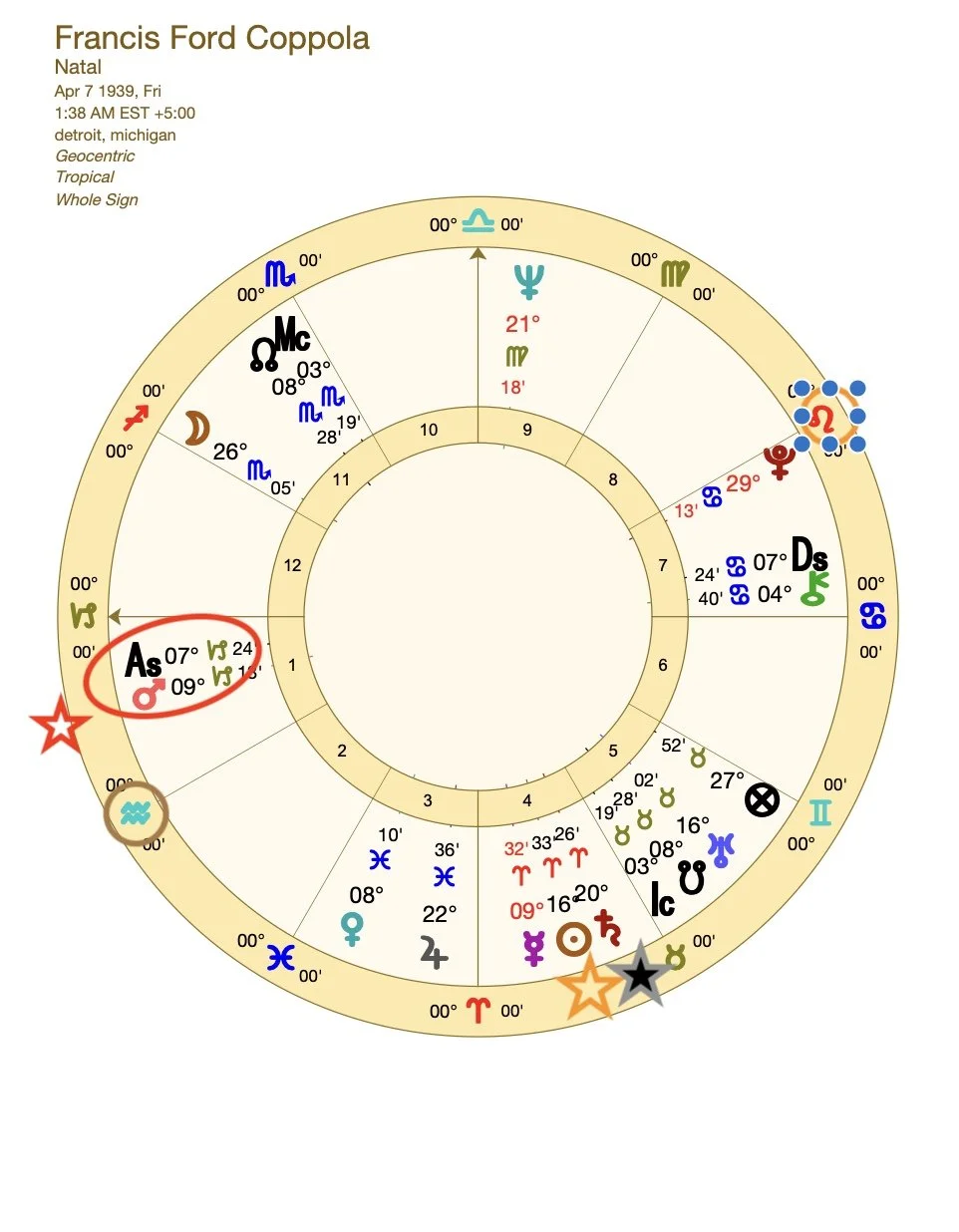
Let’s talk about that Ascendant first, and then I’ll mention a couple of other things about his chart that I think are interesting. His Capricorn I Ascendant reflects a life spent in long cycles of effort, risk, and responsibility. He wasn’t a typical director who just plotted along, working steadily from one film to the next. He would create projects, go way over budget at times, and then end up having to declare bankruptcy. He has declared bankruptcy multiple times. He would make a lot of money, especially from The Godfather, and then put a great deal of it back into films he cared about, even when that meant taking significant risks. Then he would have to go back out and work to cover the losses.
This is the harder, lower side of the energy. There can be moments where you feel very low, but then Saturn just keeps going. It’s that steady persistence. This energy has allowed Coppola, after major losses, to go right back out there and try again. There’s something really instructive about that.
I also wanted to look a little deeper into his chart because not everyone with a planet or point in this part of the zodiac is going to experience dramatic financial losses or bankruptcy. That’s not what this decan is automatically about. I was curious why the level of difficulty was so pronounced for him. I haven’t had that experience myself. I’ve had to adapt a lot and deal with things changing and stay flexible in how I create things in the world, but I haven’t had huge financial losses. So I was curious how this showed up in his chart.
We can see that his Sun in Aries, which rules his eighth house of other people’s money, is exalted, meaning it does very well there. It can also get a bit inflated and take on too much, with a sense of “I can do this.” Right next to it, we see Saturn in Aries, where Saturn is in its fall. That’s why it’s marked in black. Saturn in Aries rules his second house of his own money. So here we see difficulty around managing his own resources, combined with a strong risk-taking Sun in Aries, ruled by that exalted Mars in Capricorn. I just thought it was interesting that these two planets sit next to each other in his chart, one very powerful and ruling other people’s money, and the other struggling and ruling his own money. You can take a much deeper dive there and get a clearer picture of how that played out in his biography.
Lastly, I wanted to talk about the character Michael Corleone in The Godfather, because I think he also straddles two worlds and has to constantly adjust and adapt. That’s a deeper meaning of Capricorn I. It’s not just about financial difficulty. If we think about Michael’s role in the film, he begins as the youngest son of a powerful crime family, positioned outside the business and committed to building a legitimate, independent life. Over the course of the story, circumstances force him to step in, take responsibility, and ultimately assume leadership of the family.
That stepping in and taking responsibility is very Capricornian, since Saturn rules both the sign and the decan. The assumption of leadership also fits Capricorn I, because we have that Saturn–Jupiter combination ruling this 10 degrees. Saturn and Jupiter together can symbolize kingship or new leaders stepping forward. At the center of Michael Corleone’s story is the challenge of trying to maintain balance while everything around him is changing. He’s pulled between loyalty to his family and the desire to appear legitimate, between love and violence, between personal feeling and hard decisions. Again, that Capricorn I energy of needing to balance, stay responsive, and adapt.
There’s no moment where things really settle. Staying in control means constantly adjusting, often alone, as the pressure increases. This reflects Capricorn I not so much as ambition, but as endurance. It’s about taking on responsibility, limiting emotional expression, and carrying the weight of leadership over time rather than walking away.
I wanted to mention that again because my Moon is here. The Moon is a very personal point in the chart, and it’s often the part we identify with most deeply. That feeling of carrying responsibility, trying to keep things going, creating and expanding while doing so in a responsible way, feels very resonant with my own emotional experience. I wanted to share that with you all. I hope you enjoyed the video. If you did, it would be great if you could like and subscribe, and stay tuned. Capricorn II will be coming out soon. Have a great day.