
Sagittarius II: Battling Inner and Outer Dragons
In the video below, I explore Sagittarius II, the second decan of Sagittarius and the part of the quest where we start to meet challenges along the way. If Sagittarius I has the excitement and momentum of setting out, Sagittarius II is the moment we begin to confront real obstacles and test our resilience. With Mars and the Moon ruling this decan, there’s a blend of defensiveness, vulnerability, and emotional strength that shapes how people experience this part of the zodiac.
At its heart, Sagittarius II is about navigating difficulty while staying connected to your inner fire. The Nine of Wands in the tarot captures this perfectly: the tired but determined figure who keeps going despite wounds, setbacks, and moments of self‑protection. This decan often brings up questions of boundaries, emotional safety, and how we safeguard our passion as we move through the more complicated parts of the quest. It’s the middle stage of the journey, where old patterns surface and the body starts to respond to the challenges we meet.
In the video, I explore the imagery in the Rider–Waite card, ancient descriptions from Ibn Ezra, the Picatrix, and Agrippa, and the symbolism of Yesod on the Tree of Life. I also look at the chart of Elvis Presley, whose rising degree falls in this decan. His life reflects the full range of Sagittarius II themes: the power of instinct and emotion, the vulnerability of sudden exposure, and the struggle to protect oneself in the midst of success.
Transcript (Revised)
Hi, this is Cathy Gnatek. I continue my series on the 36 decans of the zodiac today with Sagittarius II, the second 10 degrees of the sign.
If Sagittarius I is the beginning of the quest—the moment when we move out into our journey of self‑discovery with a desire to connect with something deeper than us, with that forward action and the excitement of beginning—Sagittarius II is the moment we encounter dragons and difficulties and test our mettle around this exploration.
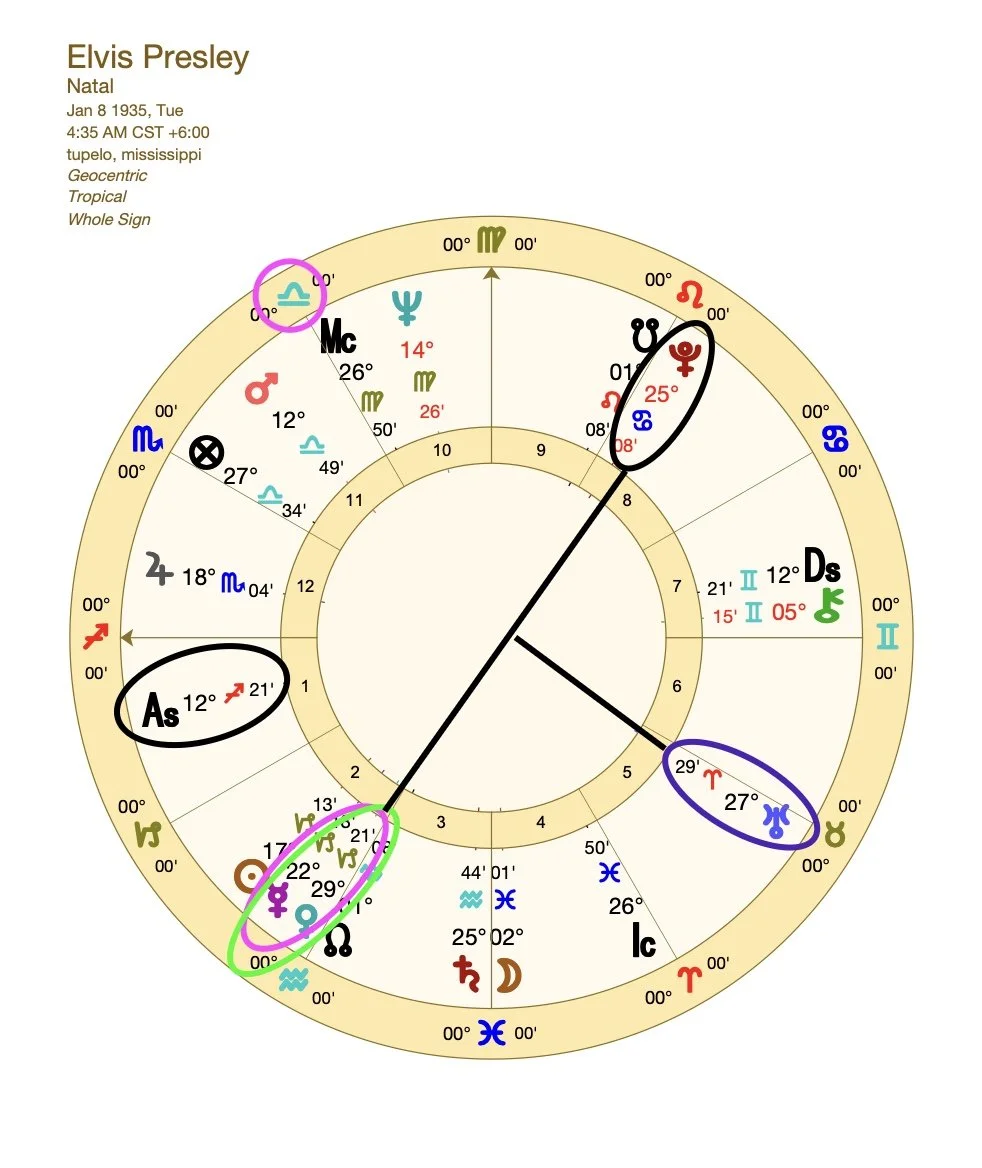
We’re going to see this with the chart of Elvis Presley, who has his rising degree in this part of the zodiac. When we consider the struggles he had to protect himself and his vulnerability while bringing his passion out into the world, we really see the planets associated with this decan, which are Mars and the Moon. Mars, the god of war and defensiveness, and the Moon, which relates to the body and our capacity to feel and respond.
I’m also going to explore the tarot card associated with this part of the zodiac, which really fits Elvis’s appearance and energy. It’s the Nine of Wands. We’ll also talk about the ancient texts connected with this decan and the Hermetic Qabbalah. There’s a lot to share. I hope you enjoy the video. If you do, I’d love it if you could like and subscribe. It helps people find me, and I’m trying to grow my channel right now.
So let’s talk about Sagittarius in general. As I said, it’s the sign of the quest. Give me one second to get to the right part. There we go.
Sagittarius is a fire sign. It’s about inspiration. It’s the image of being half human and half beast. When we think about that, it gives us a sense of the meaning‑making that can be part of the lives of people with Sagittarius placements. As human beings, we have the instinctual, animal side, but we also have the human and divine side—the part of us that can connect with consciousness, reflect on ourselves, expand awareness, and try to connect with the divine.
That’s also part of the essence of Sagittarius. When we move out into the quest for meaning—which is the core idea of the quest itself, like the quest for the Holy Grail—that’s the feeling of Sagittarius.
As I said already, Sagittarius I has to do with that beginning moment when we’re excited, we have a big idea, and we’re ready to bring it into the world with force and direction. But when we get to Sagittarius II, the decanic rulers change. Instead of having Jupiter as the ruler of the decan along with Mercury, we move to Mars and the Moon. So it’s no longer about expansion and swift movement, which belong to Sagittarius I. Now we’re encountering difficulties and conflict—Mars, the god of war, brings tension, difficulty, and protection—and the Moon brings the body, emotions, and the deepest, most vulnerable part of who we are. Those are the decanic rulers for this part of the zodiac.
We really see that expressed in the Rider–Waite tarot card associated with these 10 degrees of the zodiac. Every card in the minor arcana—all 36—corresponds to a 10‑degree section of the zodiac. Here we have the Nine of Wands. We see a moment when you’ve been out in the world and have started to battle dragons and difficulties on your path to self‑understanding. The figure has a bandage around his head. He’s been through battles. He looks tired. He has a wand in front of him, held in a protective, defensive stance, guarding the wands behind him. There’s a guarded quality tied to that Mars defensiveness and the effort to protect one’s physical being, one’s emotions, and the essence of who we are—the lunar embodiment of the soul, so to speak.
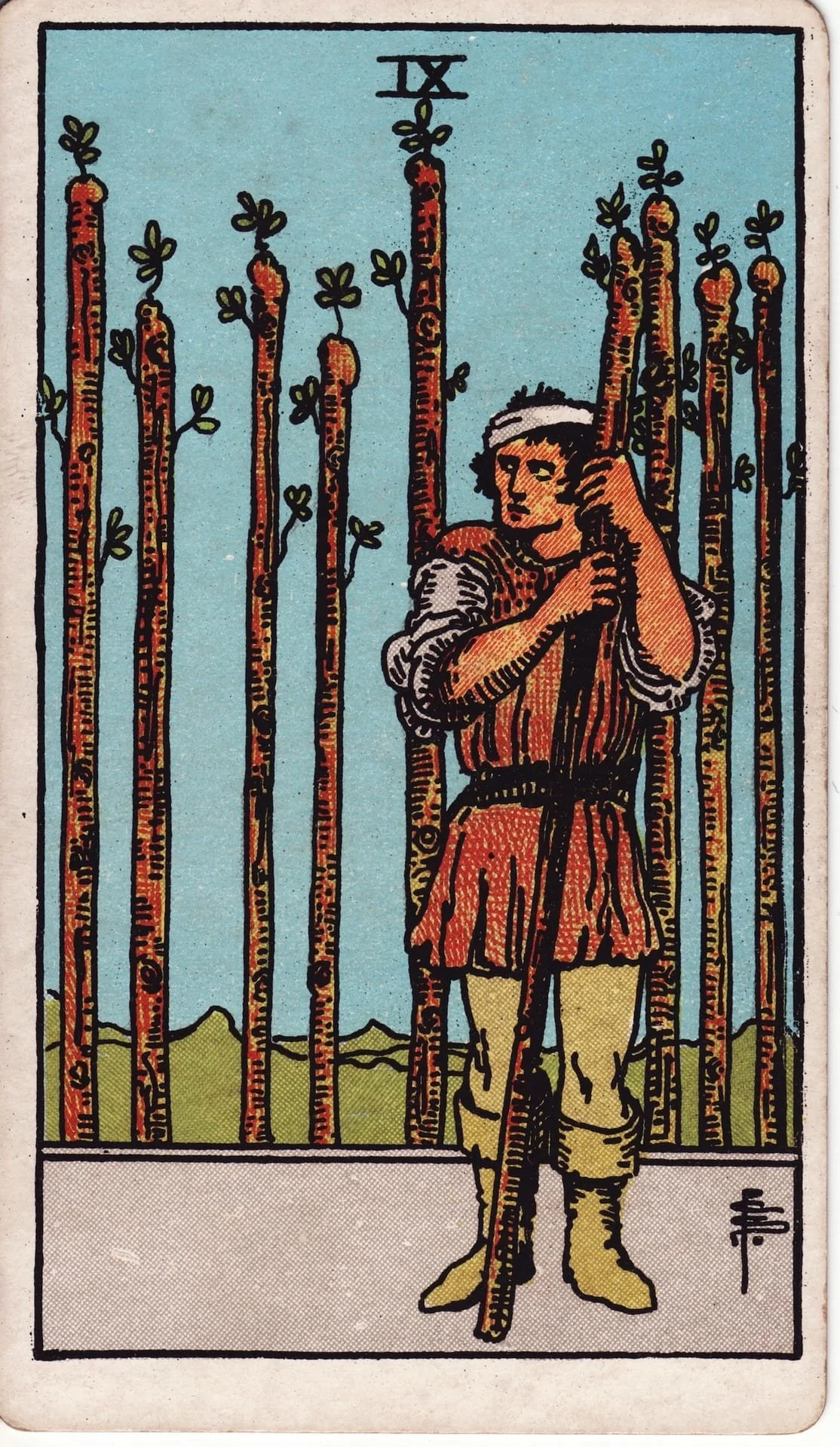
9 of Wands, Rider-Waite Tarot
And so people with points or planets in this part of the decan may be protective and vulnerable at the same time as they move out to put their passion into the world. They can also have a capacity for resilience and survival. They may struggle with questions of boundaries and have moments of hypervigilance as they try to protect themselves. But if they’re struggling with boundaries, it’s because they are actually encountering difficulties that require protection, as we’re going to see with Elvis Presley. He had people who were not kind to him—his managers and others who gathered around him in the light of his inspiration took advantage of him—and part of his path in life was to work the karma of needing to protect himself and learning the lessons around that.
The tarot card in the Thoth deck—I don’t have it here—is called Strength. So while Elvis Presley had a lot of difficulties, we also need to understand that Mars asserts itself, Mars protects itself, and Mars survives. That’s part of the energy of this section of the zodiac as well.
We can then look at the ancient texts associated with these 10 degrees. I’m going to read them one at a time and then give a bit of analysis to deepen our understanding. So first we have Ibn Ezra, and he described “a man with an open chest, white clothing, many colors, and holding a bridle.” Then the Picatrix says, “a man whose face is like a horse and having a body like an elephant. And this is a face of fear, lamentation, mourning, misery, and inquietude.” And then Agrippa describes “a woman weeping and covered with clothes. The operation of this is for sadness and fear of his own body.”
Right away we can see the Moon and Mars energy—the Moon relating to the body and its vulnerability. In Ibn Ezra, that vulnerability appears in the symbol of an open chest, as if one is exposing oneself. We can also see the beauty and abundance there, which is part of the Jupiterian, expansive, optimistic, fiery nature of this sign and this decan.
Then when we look at the Picatrix, we see more lunar anxiety—the combination of Moon (body) and Mars (potential wounding or conflict) leading to fear, misery, and difficulty. And in Agrippa we again see sadness and fear for the body. All of this adds to the explanation of the combination of Jupiter’s abundance, optimism, and outward movement with the Moon and Mars—the vulnerability of the body, the fear, and the need to protect oneself.
We’re going to see these energies in Elvis Presley’s chart. I’ll explain that at the end when we go through how it manifested for him.
But now let’s move to the Hermetic Qabbalah, which gives us the Tree of Life. It’s a mystical diagram that represents the descent of spirit into matter and manifestation. We go from the One, Keter, all the way down with this lightning‑like path to Malkuth, number 10, where we manifest inspiration in the world. And with the Tree of Life, we can see that each of the Sephirot—each of those circles—is associated with the numerology of the tarot cards. Since we’re at the Nine of Wands, we’re talking about Yesod, the number nine on the Tree of Life.

Hermetic Qabbalah, Tree of Life
We’re at a point of manifestation where we’re moving from the number eight, Hod, to the number nine, Yesod. This shift describes moving from structured thought and deliberate analysis into emotion, memory, and intuition. That is what Yesod relates to. If Hod is clarity, order, language, and conscious reasoning—the directed force of the Eight of Wands saying “I’m on the quest, I’m beginning”—then in the Nine we’re in the middle of it, and the inspiration is moving into the body, into the subtle realms, into intuition and unconscious expression. The memories we carry rise up as we channel that thought into the world. It can bring up old patterns of the soul for us to struggle with and work through.
So if the number eight says, I define, I explain, I make sense of this, the number nine says, I absorb, I respond, I feel this inside me. We’re in the body.The body brings emotions, intuition, and imagination. And that can bring up subtler levels of fear. It’s that internalized process.
Doing astrology, you can’t help but notice how it manifests in someone’s life. And so to explicate the astrology of his chart a little bit: Elvis Presley was an amazing singer. He grew up in poverty with a mother who was apparently quite anxious herself. It was a difficult upbringing. He had what we might call anxious attachment, if you know a bit of psychology. But he also had this abundance, this expansion, this optimism that he brought into his music. His Mars desire—right, Mars rules this decan—was expressed through his body, the Moon.
He brought the instinct, if we think about the centaur, that animal part of who we are, that Sagittarian energy, out into the world. And he exposed himself in a vulnerable way by bringing the force of his inner nature onto the stage. It was explosive. People, especially women, responded strongly to the sexual nature of his performance. And not just sexual in a physical sense; sex is about much more than the physical experience. It’s also about opening to the divine on some level. He brought that energy onto the stage and became very successful very quickly, and in came the people who took advantage of him—his manager among others.
So he had sudden fame and overwhelm. He didn’t have a strong sense of boundaries when he began his career, and hence, in the middle of that quest in his career, he developed a drug habit. The people around him did not support him appropriately. And if you look at that picture from the last year he was performing, it reminds you of the Nine of Wands—the worn‑down, world‑weary quality, the energy of the man with the bandage around his head, holding the stick and trying to protect himself. That hypervigilance that can come with this energy—meaning needing to protect and defend oneself, or feeling so worn from the battles along the quest that everything feels tense. We see that in that picture.
He encountered many problems. His manager pushed him to take on work and movies that didn’t suit who he was. He lost his sense of self. He was pushed into a punishing work schedule that damaged his health. The Vegas years, when he was performing on stage, drained him physically and spiritually. But he kept performing because, in some ways, he didn’t know how to stop. He didn’t have control. That may have to do with the Pluto energy I’m going to talk about in a minute in his chart.
Not everybody who has planets or points in this part of the zodiac is going to suffer to the degree that he did. But we do see the energy of encountering difficulties along the path in his life. There was a gentleness to who he was—that lunar quality of vulnerability. He had a sensitive nature, a sensitive soul, that lunar sensitivity where the body senses danger and reacts.
And yes, I know I’m repeating myself a little bit. In some ways he’s a tragic story. At the same time, there are lessons we can take from it.
I’ve seen this with many singers, and I wondered if Mercury is conjunct, right next to Venus, in his chart. And sure enough, it is. Bruce Springsteen has that. I think Tina Turner has that. I’ve seen it with a lot of singers because Mercury is the god of communication and Venus is the goddess of love, beauty, and balance. So people with Mercury and Venus together in their chart may have beautiful voices and a strong capacity to sing.
And then we see the compulsive energy around his performing, even though it was harming him—and the drugs were harming him—with Pluto, the god of the underworld, obsession, compulsion, and survival, almost exactly opposite that Mercury‑Venus energy of the singer. And Uranus, the planet of breaking free, liberation, and sudden events, is in a square, a tense relationship. So we see in the expression of his chart the expression of his life and the struggles he encountered.
So I hope you enjoyed the video. Feel free to drop a comment if you’re someone who has points or planets in this part of the zodiac and you want to chat about how it might have impacted your life. I’d love to hear about it. And I’ll see you in about 10 days for Sagittarius III. Thanks.