
Sagittarius III: The “Quest” as Karmic Teacher
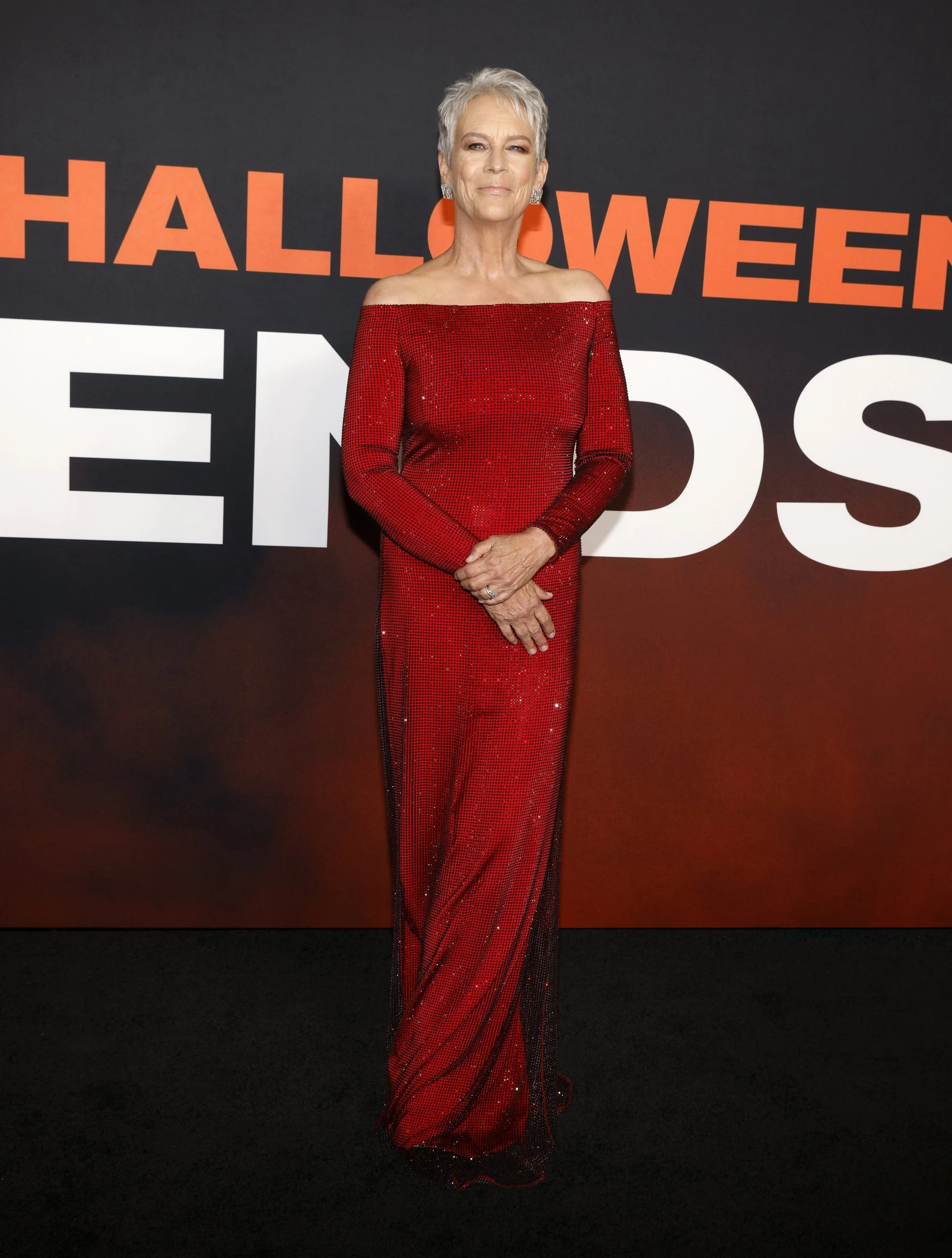
Image of Jamie Lee Curtis at the Premiere for her last film in the Halloween Series, Halloween Ends. Dreamstime.com
In the video below, I explore Sagittarius III, the third decan of Sagittarius and the part of the journey where effort becomes real. If Sagittarius I is the excitement of beginning and Sagittarius II is the push through obstacles, Sagittarius III is the point where we carry the full weight of what we started and bring it into the world.
At its core, Sagittarius III is about completion, limits, and the honest work of follow‑through. The Ten of Wands captures this clearly: the figure who keeps going even when the load feels heavy. This decan raises questions about endurance, commitment, and what we learn only by seeing something through to the end. It’s the stage where inspiration becomes material, and where our expectations meet reality.
In the video, I look at the Rider–Waite imagery, the decan rulers, the shift from Yesod to Malkuth on the Tree of Life, and how these ideas show up in daily experience. I also look at the chart of Jamie Lee Curtis, whose long connection to the Halloween films reflects the steady, disciplined, long‑range effort that defines Sagittarius III.
Transcript (Revised and Expanded)
Hi this is Cathy Gnatek. I continue my series on the 36 decans of the zodiac today with Sagittarius III, the last 10 degrees of the sign. When we get to Sagittarius III we are at the end of the quest. The sign of Sagittarius is this fire sign ruled by Jupiter a planet of expansion and optimism.
And it very much has to do with taking up a quest, a quest for meaning, trying to discern or understand oneself in light of being inspired by something larger than ourselves to move out into the world and make meaning, perhaps take up a project that allows us to make meaning out of our life.
When we get to Sagittarius III, we’re at the point where we’re exhausted by the quest and beginning to understand the limitations of our human nature. This particular decan, in addition to being ruled by Jupiter, has Saturn as one of the decanic rulers, the god of limitations and hard work, what’s possible and what’s not possible in the material world, as well as the Sun, that vision, that expansive vision. So we’re going to see that people with planets or points in this part of the zodiac are grappling with questions of what’s enough. When is their quest finished? They may be people who stick to the quest no matter what, no matter how difficult it is, and in humbling themselves and coming upon their limitations come to know something about themselves, perhaps even discover what started them on the quest to begin with.
We’ll talk about that when we talk about the chart of Jamie Lee Curtis, who has her rising degree here. She did the Halloween series over a course of 45 years and learned something in that process. She also won an Oscar at the age of 64.
We’re going to see how that fits with her becoming an actress to begin with. Both of her parents were actors. In her acceptance speech, she explains that they never received an Oscar. So it may be that she discovered, through the course of her acting career, some of her own karma around those questions of becoming an actor and what it means to her. We can think about that. I think it’s interesting.
I’ll talk, of course, about the planets I mentioned, Saturn and the Sun, ruling this decan as well. And I’ll talk about the tarot card, the Ten of Wands, and the Hermetic Qabbalah, Malkuth, that moment on the Tree of Life when we’re manifesting something in the real world. As I said, I’ll finish up by talking about Jamie Lee Curtis’s chart.
I hope you enjoy the video. If you do, it’d be great if you could like and subscribe. I’m trying to grow my channel, and I would love it.
So let’s talk about Sagittarius briefly. Let me go back up to that slide. There we go.
Sagittarius is a fire sign ruled by Jupiter, this planet of expansion and abundance. It’s the sign of the quest, this desire to find a unity between intention and action, creating coherence between spirit and body, the higher functions and lower functions.
Sagittarius is represented by the centaur, half man and half beast. The human side points to the part of us that’s capable of awareness, reflection, and a sense of something larger than ourselves. The animal side points to instinct, impulse, and the parts of our nature that move before we think. Both are real, and both operate at the same time.
So with Sagittarius, there’s this ongoing tension between the conscious, reflective part of us and the instinctive, reactive part. It’s the mix of wanting to aim toward something meaningful while still being pulled by very basic drives. Our animal nature isn’t something to deny here; it shows up as energy, momentum, appetite, and the raw push that gets us moving in the first place. And the human side is what steps back and asks what we’re doing and why.
This blend—divine or conscious on one side, instinctive on the other—is central to understanding Sagittarius. It’s not about choosing one over the other. It’s about noticing how both shape the path we end up walking.
We all, at different periods of our life, have moments where we’re taken up by some new idea that we want to explore, this quest, this question of the meaning of life. Oftentimes, the way we come to know meaning in our own life is by moving out into the world on something that has taken us up, that we’ve gotten excited about. For everyone, the quest can simply be the part of your life where you’re inspired to do something new.
When I think about Sagittarius, the tarot cards linked to this sign really spell out the story of what this sign is doing. I’ll get to the card for the last 10 degrees in a minute, but looking at the sequence as a whole helps make sense of the bigger picture. The cards move us through the entire arc of a quest. Sagittarius I connects to the Eight of Wands, which is the spark at the beginning. That’s the stage where everything is moving fast because we’re excited. There’s momentum, energy, and that feeling of “I’m finally doing this.”
Then we hit Sagittarius II, tied to the Nine of Wands. This is where things shift. We run into obstacles—sometimes external, sometimes internal. We’re no longer just riding the energy of inspiration. We’re having to deal with doubts, challenges, pushback, and the parts of ourselves that get activated when we find out the path isn’t as smooth as we imagined. It’s the point where we have to protect what we’re building and get clear about what actually matters.

The 8, 9, and 10 of Wands, Rider-Waite Tarot (Corresponding to Sagittarius I, II, and III respectively)
And finally, Sagittarius III brings us to the Ten of Wands. This is the last stretch of the quest, where we’ve been carrying the goal for a long time and the weight is real. The excitement of the beginning is gone; now it’s about follow‑through. This is where we feel the limits of being in a human body with finite energy and attention. It’s not dramatic—just the honest truth that finishing something takes more out of us than starting it. And that’s part of the message here: the end of the quest isn’t shiny or romantic. It’s work, it’s effort, and it teaches us something we couldn’t have learned any earlier on the path.
All the vision that we had, the inspiration, that fiery inspiration of what we might accomplish, we’re coming to know maybe we’re not going to be able to get everything we wanted with that original vision. And so there’s something about people with points or planets in this part of the zodiac that these are the questions they struggle with. They may come into circumstances where they realize they’ve been pushing themselves too hard to get everything they want and that they need to lay down some of the burden, not take it all upon themselves, and be realistic about what’s possible. At the same time, they have a tenacity that demands that they move forward to completion. Even if there are difficulties, they are going to put in the hard work over a long period of time to get to that goal.
And we can really see this exemplified in the chart of Jamie Lee Curtis. We’re going to talk about that at the end. But that idea of tenacity for the vision, Saturn, Sun. Saturn rewards hard work over a long period of time. And Saturn wants to finish things. It feels super responsible.
Let me jump back for a moment because I realized I skipped a slide earlier. I want to briefly touch on the decanic rulers for Sagittarius III. Along with Jupiter, this part of the zodiac is ruled by the Sun and Saturn. The Sun is the center point in our system, the thing everything else moves around. It has a steadying, clarifying quality—warmth, intention, and the ability to see what’s right in front of us. Daylight makes things obvious. We can name what we’re aiming for.
Then we mix that with Saturn. And Saturn basically says, “Fine, you have the vision, but now you actually have to earn it.” Saturn brings limits, structure, and the kind of work that isn’t optional if you want to finish something. It cuts out what doesn’t belong, and it reminds us that effort has a cost. Anyone who has pushed through a long project knows what that feels like—there’s physical fatigue, mental strain, and the sense that the only way out is through. This ties right back into the themes of the Ten of Wands, which I’ll get to again in a second.
That brings us to the card itself. The Ten of Wands in the Rider–Waite deck shows a man hunched forward, carrying all ten wands at once. They’re awkward, heavy, and he can barely see where he’s going. But he’s still moving toward the small town ahead of him. He’s almost done, but the last part of the journey is the hardest. You can feel the weight he’s carrying and the strain in his body. It’s that familiar moment when you’re close to finishing something, but the final push takes everything you’ve got.
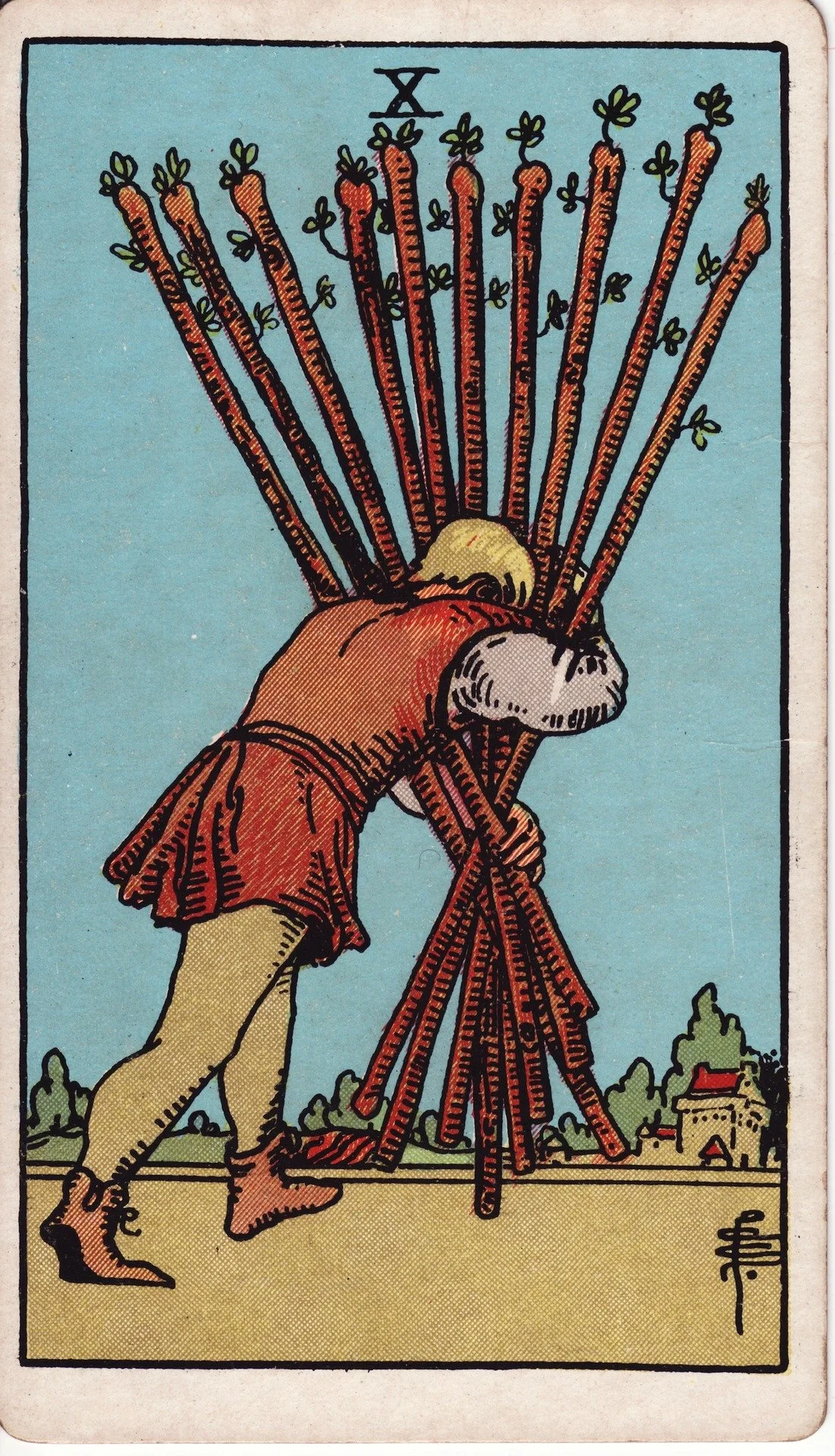
10 of Wands, Rider-Waite Tarot
And when you pull this card in a tarot spread, depending on the cards that are near it, it might be a moment of exhaustion where you need to think about, can I carry this burden? Or is it time to set it down for a little while or pare it back?
And yes, this card absolutely points to exhaustion and the feeling of being at your limit. I have my South Node in this part of the zodiac, so I know this energy pretty well. Even though Sagittarius III can feel heavy, it isn’t only about being overloaded. Anytime we get to a ten in the tarot—or to Malkuth on the Tree of Life—we’re dealing with something that’s finally taking shape in the real world. We’ll get to that more in a minute.
What matters here is that completion isn’t just an ending. It functions like a feedback loop. By the time we reach the end of a suit, we’ve gone through the full arc of its energy, and something gets integrated in the process. So if we limit this decan to “you’re doing too much, put the load down,” we miss the point. There’s also value in finishing something, even when it’s demanding. Sticking with a project through its limitations, choosing not to give up, and accepting the small, unglamorous parts of the work teaches us something about who we are. There’s humility in that, but also a deeper kind of self‑knowledge that only shows up at the end of a long effort.
I also thought it was interesting that Rachel Pollock picks up on a similar idea in her book. One of the points she makes about this card—mixed in with my own take—is that the Ten of Wands can point to a kind of new life or a clearer sense of what your “Holy Grail” actually is. And by Holy Grail, I just mean the deeper meaning behind the actions you take and the things you throw your energy into. We usually start a project because something sparks us, but we don’t actually understand the full reason for it until we’re on the other side of finishing it.
So there’s this pattern where a new idea hits, we jump in, everything feels exciting at first, then the hard work starts piling up. The middle part is often messy and tiring. But once it’s done, once the quest is completed, that’s when the clarity shows up. That’s when we understand why we took it on in the first place. And you can see this dynamic really clearly in Jamie Lee Curtis’s long involvement with the Halloween films and how that threads through her life. I’ll get into that in a moment.
We could talk about the ancient texts connected with this decan, but I’m not going to go too deep into them this time. I’ll leave the slide up so you can pause and read them if you want. A lot of these descriptions do touch on Sun themes—gold, clarity—and Saturn themes—limits, hardship—but overall, I don’t think they capture the feel of this part of the zodiac very well. They lean more toward the shadow side, and that’s not really what I’m focusing on here.
If you read them and see something I didn’t, feel free to share your thoughts in the comments. I’m open to hearing different interpretations. For me, though, these particular texts didn’t add much to the story of this decan, so I’m setting them aside for now.

Tree of Life, Hermetic Kabbalah
So then let's go to the Tree of Life. This is the Hermetic Qabbalah. It's a mystical diagram that represents the descent of divine inspiration into the material world. The lightning flash traces the flow of creative energy from divine source at Kether here at the top. So Kether up here at the top. And then we see the lightning flash as spirit descends into matter. And we go through each of the ten spheres of these energies in our life. There's a path where you have them first entering and then, as I said earlier in the video, there's a way in which as we try to bring spirit into matter, we're going to lose energy all the way along this lightning path.
And then ultimately at Malkuth, which is where we're at now, from the nine, which is Yesod, to Malkuth, which is ten on the Tree of Life. The number ten, as I said earlier, corresponds to the Sephirah of Malkuth, the final Sephirah on the Pillar of Form, the realm of manifestation, completion, embodiment, physical reality. Everything I've been saying about we're at the end of the quest, we want to get that project done and make it real— that's part of the energy of Malkuth. It's a point of, okay, the rubber hits the road and what will we accomplish.
Moving from Yesod to Malkuth describes the shift from the subtle inner imaginal world into full material expression. So if you go back to the Nine of Wands, which corresponded to Sagittarius II, that was a moment where we were encountering dragons. They could be internal or external, where we encounter problems on our path, where we’re having conflicts with people, but it also can be internal conflicts and imaginings about what may go wrong, etc. And now we’re moving into, okay, I’m going to move forward and complete this quest. And in the Ten of Wands the burden has become literal. Instead of all those imaginings, we’re getting to now having to carry that heavy load forward into reality.
The figure in the Ten of Wands bears the accumulated results of the entire suit of Wands. Fire that’s run its course and now must be grounded in something real. And this is Malkuth’s lesson. The culmination of the quest, the point where everything gathered along the path becomes tangible. And much of that just reiterates the Ten of Wands in general. You know, the Rider–Waite, when they created the cards, they were working with the notions from the Qabbalah at the same time, just so you get a feel for that.
Let’s talk about Jamie Lee Curtis, because she’s a useful example here, she has her rising degree in Sagittarius III. She took on the Halloween films early in her career and stayed with that character, Laurie Strode, for decades. These are horror films—full disclosure, I’ve never watched one because that genre is too much for me—but I’ve followed Jamie Lee Curtis’s work and have always respected her.

What’s striking about her long relationship with this series is how clearly it shows her growth. She first stepped into the role in the late 1970s, and she didn’t close that chapter until more than forty years later. That whole arc reflects the feeling of Sagittarius III: you take something up when you’re young and don’t fully understand the long view, you carry it for a long stretch of life, and eventually you reach the point where you can finish it with intention.
By the time she worked on Halloween Ends, she wasn’t just acting in the franchise anymore—she was producing it. That changed everything. Producing gave her the ability to shape the story, adjust the tone, and present Laurie Strode in a way that felt more honest for who she had become as a mature adult. Instead of repeating the same trauma patterns, the story let the character do some emotional work, and you can feel the shift. The horror is still there, but the framing is different. There’s survival, but also actual growth.
If you look back to how she started, the choice to take the role likely came from a young actor wanting work and getting an opportunity. Both her parents were actors, so the path itself was familiar. Like many beginnings, it may have been instinctive and enthusiastic, without a sense of the long arc ahead. Over time, though, she moved from simply participating in the story to shaping it. By the final film, she wasn’t just returning to a character—she was closing out the narrative in a way that matched her values and her voice.
That’s very much the tone of Sagittarius III: starting with excitement, shouldering the work for years, moving through limitations, and eventually taking ownership of how the story ends.
It’s also notable that she stayed with this character for forty‑five years. That kind of consistency reflects Saturn’s influence: the steady, committed work of finishing what you start. And then, at age sixty‑four, she won her first Oscar for Everything Everywhere All at Once. Saturn themes show up there too—recognition that arrives later in life, after sustained effort.
In her acceptance speech, she mentioned that both of her parents, Janet Leigh and Tony Curtis, had been nominated for Oscars but never won. She became emotional when she said it. You could feel that the award connected to something bigger than just her performance. It was as if the quest she had carried—professionally and personally—had reached its endpoint.
This connects back to what I said earlier about the Ten of Wands. Finishing something can reveal its meaning only in hindsight. We don’t always know why we take up a project. We think we know, but often the deeper reason becomes clear only after we’ve done the hard work and followed it through to completion.
So with Jamie Lee Curtis, you can imagine that taking that early role might have started as simple enthusiasm for acting. Over time, as she gained experience and authority, she could reshape the narrative, step into her own power, and guide the story toward an ending that felt right. And when she finally received that Oscar, it carried the weight of completion—like crossing the finish line of a very long quest that began before she even understood what it would become.
She was born into an acting family. And any good psychologist knows that oftentimes we can kind of take up our parents' desires. Not that she didn’t also desire to be an actress and move into this, but there’s something very poignant about her acknowledging that it was so meaningful for her to win this Oscar as though she was winning it for her parents.
I’m going to give one last thought on this as somebody who has their South Node in this degree, to talk about the idea of not knowing in advance why we’ve taken something up. A couple of examples from my life. One is this series on the decans. I felt compelled to start it. I didn’t know why. And I’m still not sure why because we’re not to the end. But what I have discovered is the reality that the project has changed from the beginning, so that’s the flexibility or mutability of Sagittarius, that adapting to the quest as you go along can be very important, that it is a heavy burden, but that I’m so committed to finishing it, which I think is interesting and very reflective of this Sagittarius, the third part of Sagittarius.
And that I’m discovering that it’s not about creating content for other people. I enjoy doing that. But it’s much more about getting to know myself through doing the work of creating these videos. It deepens my knowledge of astrology. And every time I do a new decan, something new opens up to me about the zodiac. And also for myself, about my own self‑understanding. There’s always some correspondence between the energy of the decan and what’s happening in my life at any particular time. So there’s this way in which it turns out astrology is teaching me. And I’ve always thought that and experienced it many times, but it’s really deepened with this particular project.
And so anyway, I think that’s enough. But I love doing this. And again, I am trying to grow my channel because I feel called to. Not necessarily for the sake of money or anything else. But teaching is something that is clearly what I am to bring into the world. It’s what gives me joy, and it teaches me to actually share this information. So I hope you all enjoy it. And I’ll see you in about 10 days for Capricorn I. We’re three‑quarters of the way through this project. I’m so excited. The finish line is ahead. Have a great day.